Recubrimiento superficial, recubrimiento al vacío e impregnación al vacío en el procesamiento de alimentos
Los procesos de recubrimiento se utilizan en la industria alimentaria para aplicar sabores, ingredientes funcionales o capas protectoras a los productos alimenticios. Estas tecnologías influyen en el sabor, la textura, la apariencia, la estabilidad y el valor comercial del producto.
Los sistemas de recubrimiento industrial permiten una interacción controlada entre los productos alimenticios y líquidos o polvos como aceites, condimentos, jarabes, chocolate, adobos o aditivos funcionales. Según el resultado deseado, el recubrimiento puede realizarse en condiciones atmosféricas para la aplicación superficial o en vacío para una infusión más profunda de los ingredientes.
Las tecnologías de recubrimiento modernas se utilizan en una amplia gama de sectores alimentarios, incluyendo la producción de snacks, confitería, procesamiento de frutas y verduras, y procesamiento de carne o proteínas. Las aplicaciones comunes incluyen el aderezo de snacks, el recubrimiento de chocolate, la infusión de jarabes de frutas y el marinado acelerado de productos cárnicos.
Selección de la tecnología de recubrimiento adecuada
La tecnología de recubrimiento óptima depende de las características deseadas del producto.
| Tecnología | Uso típico |
| Mezcladoras de tambor rotatorio | Condimentación superficial continua y distribución de polvo |
| Recubrimientos rotatorios | Sazonado de superficies, distribución de polvo y recubrimiento líquido |
| Sistemas de recubrimiento al vacío | Infusión interna de sabor en productos porosos |
| Sistemas de impregnación al vacío | Saturación profunda de líquido e incorporación de ingredientes funcionales |
En muchas plantas de producción de alimentos, se utilizan diversas tecnologías de recubrimiento según el tipo de producto y los objetivos de producción.
Desde la perspectiva de la ingeniería y la producción, la tecnología de recubrimiento es importante porque afecta directamente a:
- el rendimiento del producto
- la eficiencia en el uso de ingredientes
- la distribución del sabor
- la diferenciación del producto
- el valor total por kilogramo de producto terminado
Sistemas de recubrimiento superficial convencionales
Mezcladoras de tambor rotatorio
Las mezcladoras de tambor cilíndrico rotatorio se utilizan comúnmente en la producción de snacks y alimentos secos. Estos sistemas se emplean para:
- sazonar patatas fritas y galletas
- recubrir snacks extruidos
- aplicar aceites y mezclas de sabor
- distribuir polvos y partículas finas
El principio de funcionamiento se basa en el volteo mecánico. A medida que el tambor gira, el producto se eleva y cae continuamente, creando una zona de mezcla dinámica que permite que los ingredientes se distribuyan por toda la superficie del producto.
Los ingredientes líquidos o en polvo se introducen mediante boquillas de pulverización o sistemas de dosificación. Según la aplicación, el tambor puede contener paletas internas o elementos de mezcla que mejoran el movimiento del producto y la uniformidad del recubrimiento.
Los parámetros importantes del proceso incluyen:
- tiempo de procesamiento
- velocidad de rotación
- tamaño de las gotas de pulverización
- relación de carga del producto
- características de absorción de humedad y aceite
Los sistemas de recubrimiento en tambor son muy eficientes para la aplicación de ingredientes en la superficie, pero la profundidad de penetración de los líquidos generalmente se limita a la estructura externa del producto.
Recubrimientos en bandeja para aplicaciones de chocolate y azúcar
Los recubrimientos en bandeja rotatoria se utilizan con frecuencia en la producción de confitería. Las aplicaciones típicas incluyen:
- frutos secos recubiertos de chocolate
- grageas recubiertas de azúcar
- racimos de cereales
- inclusiones en snacks funcionales
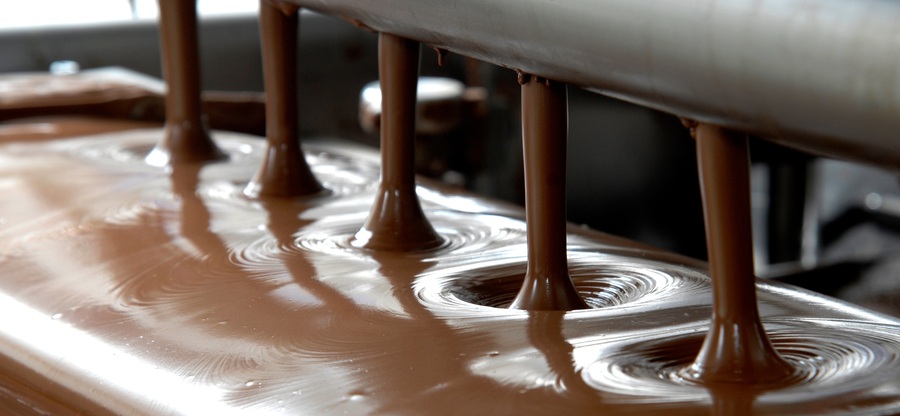
En estos sistemas, el producto gira dentro de una bandeja mientras se añade gradualmente chocolate líquido, jarabe o solución de azúcar en cantidades controladas. Simultáneamente, se aplica un control del flujo de aire para regular el enfriamiento o el secado, lo que favorece la formación de capas de recubrimiento sucesivas.
Los procesos de recubrimiento por capas requieren el control de varios parámetros:
Temperatura del producto
La temperatura del producto debe controlarse cuidadosamente para garantizar una correcta adhesión y solidificación del material de recubrimiento. Si el producto está demasiado caliente, el recubrimiento puede permanecer líquido y provocar adherencia o aglomeración. Si la temperatura es demasiado baja, el recubrimiento puede solidificarse rápidamente y formar capas irregulares.
Viscosidad del material de recubrimiento
La viscosidad del chocolate, el jarabe u otros líquidos de recubrimiento determina la facilidad con la que el material se extiende y forma capas sobre la superficie del producto. Una viscosidad adecuada garantiza una cobertura uniforme sin acumulación excesiva, goteo ni distribución irregular.
Flujo de aire y humedad
Un flujo de aire controlado favorece el enfriamiento, el secado o la cristalización de la capa de recubrimiento durante el proceso. También es necesario controlar los niveles de humedad para evitar la condensación, que puede afectar negativamente la textura, la calidad de la superficie o la estabilidad del producto.
Dinámica de rotación de la bandeja
La velocidad de rotación y el patrón de movimiento de la bandeja de recubrimiento influyen en cómo se mezcla y se agita el producto. Una dinámica de rotación adecuada garantiza un movimiento continuo del producto, una distribución uniforme del recubrimiento y evita la aglomeración o el daño mecánico.
El objetivo es crear una capa de recubrimiento uniforme sin aglomeración, adherencia ni defectos en la superficie del producto.
Tecnología de Recubrimiento al Vacío
El recubrimiento al vacío es un método avanzado que mejora la penetración de ingredientes en productos porosos. A diferencia de los sistemas convencionales que operan a presión atmosférica, el recubrimiento al vacío utiliza una reducción controlada de la presión para permitir una infusión más profunda de líquidos en la estructura interna de los alimentos.
Esta tecnología se utiliza en la fabricación de snacks, el procesamiento de frutas y el procesamiento de proteínas para lograr una distribución de sabor más uniforme y una mayor absorción de ingredientes.
Muchos alimentos contienen microestructuras internas llenas de aire, como:
- Matrices de snacks
- Tejidos de frutas y verduras
- Estructuras de fibra proteica
En condiciones atmosféricas, estas bolsas de aire limitan la penetración de líquidos en el producto.
El recubrimiento al vacío funciona mediante el siguiente mecanismo:
- El producto se coloca dentro de una cámara giratoria sellada.
- La presión del aire dentro de la cámara se reduce, lo que provoca que el aire atrapado en la estructura del producto se expanda y escape parcialmente.
- Se introduce el saborizante líquido o una solución funcional mientras la cámara permanece al vacío.
- Cuando se restablece la presión atmosférica, la diferencia de presión fuerza al líquido a penetrar en los poros previamente ocupados por aire.
Este mecanismo permite una infusión significativamente más profunda y uniforme en comparación con la pulverización superficial convencional.
Ventajas del recubrimiento al vacío
- Mayor eficiencia de absorción de líquidos y saborizantes
- Menor consumo de ingredientes
- Distribución más uniforme del sabor en todo el producto
- Mayor diferenciación del producto mediante la infusión interna de sabor
- Mayor estabilidad de los ingredientes aplicados
- Menor oleosidad superficial en ciertas aplicaciones
- Posible mejora de la vida útil gracias a la eliminación del aire atrapado
En la producción de snacks, el recubrimiento al vacío permite una alta intensidad de sabor sin exceso de polvo en la superficie. En el procesamiento de frutas y verduras, permite la infusión de jarabes de azúcar, vitaminas o aditivos funcionales. En el procesamiento de proteínas, mejora significativamente la absorción y distribución del adobo.
Tambores y difusores al vacío para el procesamiento de carne
El procesamiento al vacío se utiliza ampliamente en las industrias cárnica y proteica. Los tambores y difusores al vacío combinan la reducción de presión con la agitación mecánica para acelerar la absorción del adobo.
Durante el volteo al vacío:
- Se reduce el aire atrapado en el tejido muscular.
- Se acelera la penetración del adobo.
- Puede aumentar la extracción de proteínas.
- Mejoran la retención de humedad y el rendimiento del producto.
El volteo mecánico mejora aún más la transferencia de masa y garantiza una distribución uniforme de ingredientes funcionales como sal, fosfatos o saborizantes.
Tecnología de impregnación al vacío
La impregnación al vacío está estrechamente relacionada con el recubrimiento al vacío, pero está diseñada específicamente para la saturación interna profunda de productos porosos con soluciones líquidas. Las cámaras de impregnación al vacío son unidades industriales selladas que se utilizan para introducir líquidos como adobos, jarabes, vitaminas, aceites o conservantes en la estructura interna de los poros de los alimentos.
En el procesamiento de alimentos, el vacío se utiliza con mayor frecuencia para reducir la temperatura de ebullición de los líquidos. Sin embargo, en los sistemas de impregnación, el vacío funciona principalmente como un mecanismo de transferencia de masa.
El proceso de impregnación al vacío generalmente incluye tres etapas:
1. Etapa de vacío
Se extrae el aire de la cámara sellada. El gas atrapado en los espacios intercelulares del producto (por ejemplo, dentro de los poros de las frutas o en las fibras musculares de la carne) se expande y escapa.
2. Etapa de inmersión
El producto se sumerge completamente en la solución de impregnación, que puede consistir en:
- adobos
- jarabes
- soluciones vitamínicas
- concentrados de ingredientes funcionales
3. Etapa de restablecimiento de la presión
Se reintroduce aire atmosférico en la cámara. La diferencia de presión resultante fuerza al líquido circundante a penetrar en los poros que antes estaban ocupados por el gas. Este mecanismo hidrodinámico permite una penetración profunda y uniforme del líquido en toda la estructura del producto.
Aplicaciones de los impregnadores al vacío
La impregnación al vacío se utiliza en diversos sectores de la industria alimentaria:
Procesamiento de carne y pescado
Se pueden lograr procesos rápidos de marinado y curado. La exposición al vacío abre los poros y las fibras del tejido muscular, permitiendo que las especias y la salmuera penetren profundamente en 15-30 minutos en lugar de varios días.
Procesamiento de frutas y confitería
Las frutas, bayas y frutas confitadas pueden impregnarse con jarabes, conservando su estructura y color, y evitando un procesamiento térmico prolongado.
Producción de alimentos funcionales
Las estructuras alimentarias porosas, como las manzanas, los cereales o los tejidos vegetales, pueden enriquecerse con:
- vitaminas
- minerales
- probióticos
- antioxidantes
Fabricación de snacks
Los aromatizantes o aceites se incorporan a la estructura interna del producto, logrando una distribución del sabor más uniforme en comparación con el sazonado superficial.
Las principales ventajas de la impregnación al vacío incluyen:
- Penetración profunda: El procesamiento al vacío permite una impregnación completa o muy profunda en comparación con los métodos de remojo convencionales.
- Reducción del tiempo: Los procesos que normalmente requieren varios días a menudo se completan en pocas horas.
- Mejora de la calidad del producto: Se eliminan las burbujas de aire y las áreas internas sin tratar, lo que resulta en propiedades más uniformes del producto.
- Conservación de las propiedades del producto: Las bajas temperaturas del proceso ayudan a mantener las vitaminas termosensibles y los sabores naturales.
- Mayor vida útil: Reemplazar el oxígeno dentro de los poros con soluciones protectoras puede ralentizar la oxidación y el crecimiento microbiano.
- Mayor eficiencia del proceso: Una absorción más eficiente reduce los tiempos del ciclo de producción y el consumo de ingredientes.
Consideraciones técnicas
La implementación de tecnologías de recubrimiento, recubrimiento al vacío o impregnación al vacío requiere un control preciso de varios parámetros del proceso:
- Porosidad y estructura interna del producto
- Viscosidad de los líquidos de recubrimiento o impregnación
- Control de la temperatura
- Velocidad de rotación y tensión mecánica
- Nivel de vacío y duración del ciclo
Una selección incorrecta de parámetros puede provocar un recubrimiento irregular, daños en el producto o un uso ineficiente de los ingredientes.
Los equipos industriales modernos suelen incluir:
- Velocidades de rotación ajustables mediante convertidores de frecuencia
- Sistemas de dosificación automatizados
- Ciclos de vacío programables
- Control integrado de temperatura y flujo de aire
Estos sistemas permiten la adaptación a diferentes tipos de productos y condiciones de procesamiento.
Los procesos de recubrimiento son fundamentales para lograr el sabor, la textura y la estabilidad deseados en los productos alimenticios, y por lo tanto, desempeñan un papel importante en la diferenciación de productos en el mercado. Los sistemas de recubrimiento atmosférico se utilizan normalmente para la aplicación superficial de aceites, polvos y jarabes; la tecnología al vacío amplía significativamente las posibilidades de procesamiento al permitir una infusión profunda de ingredientes.
El recubrimiento y la impregnación al vacío permiten a los productores de alimentos desarrollar productos alimenticios innovadores con mayor valor comercial, al mejorar la distribución del sabor, reducir el consumo de ingredientes y aumentar la versatilidad general del producto.