When processing viscous and heterogeneous food products, mixing efficiency depends on more than just drive power and agitator geometry. For sauces, jams, creams, fruit fillings, and other high-viscosity products, it is critical to ensure movement throughout the entire batch, including the zones near the walls and the heated bottom.
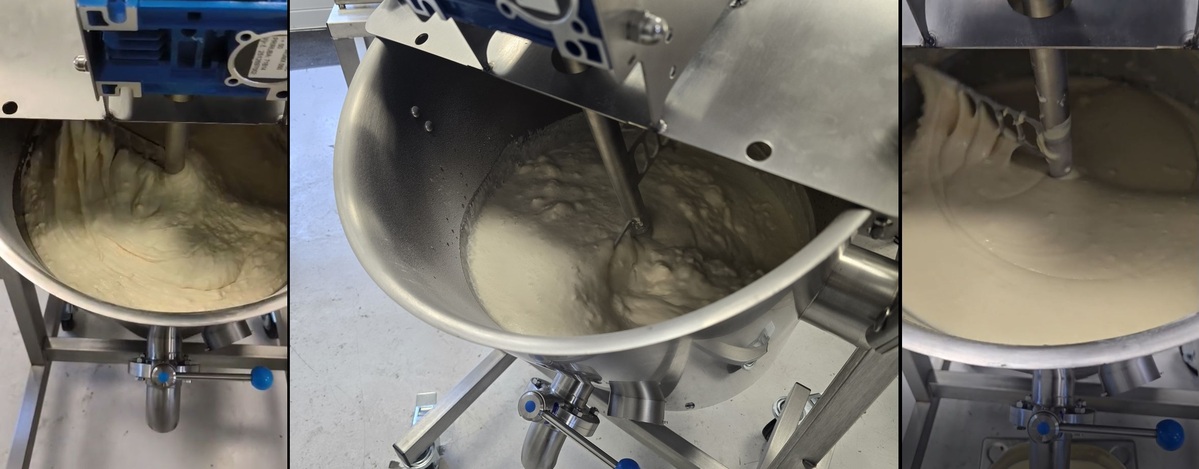
In CookMakMix electric cooking kettles, with capacities ranging from 20 to 150 liters, this challenge is addressed by combining mechanical agitation with controlled adjustments to the vessel's tilt. Tilting the kettle causes the product to shift under its own weight, effectively turning gravity into an additional component of the mixing process.
The Gravity-Assisted Mixing Principle
In a standard vertical kettle, product movement is generated primarily by the agitator. The higher the product's viscosity, the more difficult it becomes to ensure vigorous exchange between different areas of the vessel without increasing rotation speed or torque.
The CookMakMix features 13 fixed tilt positions. Changing the vessel angle alters the position of the product relative to the agitator and the heated surface: the product naturally shifts toward the lower side of the vessel, while the mechanical agitator returns and redistributes it within the working volume.
This creates two simultaneous mechanisms of movement: mechanical agitation and gravity-driven product displacement. Instead of attempting to drive circulation solely through the rotation of the mixing tool, the product's own weight is utilized. This effect is particularly pronounced when processing viscous and semi-viscous products.
Minimizing Dead Zones When Processing Thick Products
A major challenge with agitated cooking vessels is the formation of areas with poor circulation. In these zones, the product remains in contact with the heated surface for longer, exchanges heat more slowly with the rest of the batch, and may exhibit a different local temperature.
Adjusting the tilt of the Cook Mak Mix changes the geometry of product movement relative to the agitator. The product constantly tends to shift toward the lower section of the tilted vessel, where it is once again engaged by the mixing tool. This helps minimize persistent dead zones and improves circulation during the production of:
- sauces and ketchups
- jams and fruit preserves
- fruit and berry fillings
- creams and custards
- purées
- syrups and other high-viscosity products
For the process engineer, this translates into a more uniform distribution of ingredients and temperature throughout the batch, without relying solely on increased agitator speed.
Scraper Agitator and Gravity Working as a Unified System
When processing viscous products, the zone where the product directly contacts the heated surface is of critical importance.
The Cook Mak Mix can be equipped with a scraper agitator. The scrapers continuously remove the product layer from the bottom and walls, refreshing the product within the heat exchange zone. Simultaneously, the vessel's tilt causes the mass to shift relative to this surface.
This creates a continuous cycle: surface heating, removal of the heated layer by the scrapers, gravity-driven product movement, and redistribution of the mass by the agitator. This combination enhances circulation and reduces the risk of product buildup on heated surfaces.
13 Operating Positions Instead of a Fixed Vessel Position
The tilting function of the Cook Mak Mix is not merely intended for unloading; it is also utilized directly during the processing stage.
The system offers 13 operating positions, allowing the angle to be selected based on product viscosity, load volume, and the desired mixing dynamics.
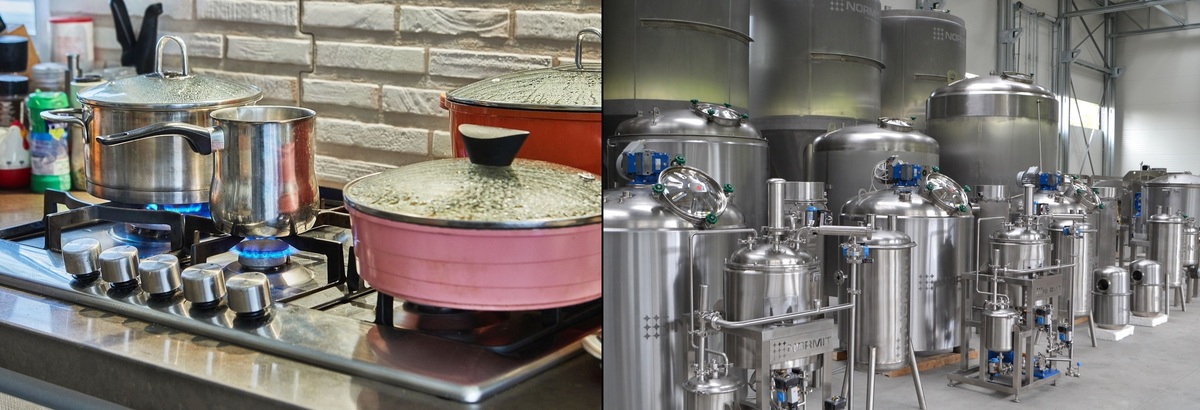
This differs fundamentally from standard cooking kettles, where the vessel remains vertical throughout the cooking process and the tilting mechanism is used only after the process is complete. With the Cook Mak Mix, the position of the mixing vessel itself becomes an additional adjustable mixing parameter.
Multi-Layer Sandwich Bottom and Uniform Heating
Gravity-assisted mixing is only effective when heat exchange is properly managed. In the Cook Mak Mix, electric heating elements are integrated into a multi-layer sandwich base. This design distributes heat flow across the working surface and minimizes localized overheating.
At the same time, the agitator continuously moves the product through the heated zone, while tilting the vessel alters the product's flow paths.
Thus, the heating and mixing systems work in tandem. The objective is not merely to transfer heat through the base, but also to constantly refresh the layer of product in contact with the heated surface.
Quick Agitator Exchange
A single cooking vessel is often used for multiple products with vastly different rheological properties. In such scenarios, a universal agitator is inevitably a compromise.
In the Cook Mak Mix, the mixing tool connects to the shaft via a quick-release coupling. The agitator can be changed manually in seconds and without tools.
Depending on the product, various types of mixing tools can be used, including anchor, paddle, and scraper systems. This allows a single unit to be adapted to different processing tasks without complex mechanical reconfiguration.
Tilting up to 110° and Controlled Discharge
The tilting mechanism allows for a maximum tilt angle of 110°. This angle goes beyond the standard operating positions and is designed primarily to ensure the most complete product discharge possible. Gravity causes the mass to shift toward the discharge zone, which is a crucial feature for viscous products that do not flow easily out of a vertical vessel under their own weight.
Additionally, the design supports reverse tilting, or tilting in the opposite direction. This changes the direction of product movement and accumulation within the vessel, giving the operator greater control during mixing, discharge preparation, and operation of the scraper system.
Consequently, the same mechanism performs two processing functions: it manages the gravitational component of mixing during the process and ensures controlled removal of the finished product upon completion.
Why Gravity-Assisted Mixing Is Effective for Viscous Products
When viscosity increases, simply raising the agitator speed is rarely the optimal solution. While it increases mechanical stress on the drive and the product, it does not guarantee a proportional improvement in the circulation of the entire batch.
Using a tiltable vessel alters the fundamental hydromechanical dynamics of the process. Part of the work involved in moving the mass is performed by gravity rather than by the electric drive.
Therefore, it is more accurate to view the Cook Mak Mix concept not merely as a cooking kettle equipped with an agitator and a tilting mechanism, but as a system in which heating, mechanical agitation, scraping action, and gravity-driven product movement work in tandem.
For small to medium batches ranging from 20 to 150 liters, this approach is particularly beneficial in the production of sauces, jams, creams, fillings, and other products that require uniform heating, intensive circulation, and minimal product residue upon discharge.
Conclusion
The primary engineering advantage of gravity-assisted mixing lies not in replacing the mechanical agitator, but in adding a second mechanism for product movement.
In the Cook Mak Mix series, the agitator generates forced circulation, while the adjustable vessel tilt uses the product's own weight to change the direction of its movement. These features work together as an integrated processing system: 13 operating positions, scraper mixing elements, a multi-layer sandwich bottom, rapid tool-free agitator exchange, and a maximum tilt angle of 110°.
For viscous food products, this configuration helps reduce dead zones, improve heat transfer and mass circulation, and, after the process is complete, accelerate and provide greater control over product discharge.
Technical Data Source:
Official Cook Mak Mix series page - Electric tilting cooking kettle with scraper agitator