Choosing the most efficient mixing method is one of the most important consideration when setting up commercial production, as thorough mixing is necessary for pretty much every production process. Conventional mixers rely primarily on the mechanical action of an agitator to move the product through the vessel. While this works well for many applications, dense products can resist movement and form areas where circulation is limited.
Gravity-assisted mixing provides an additional force that can help move the product through the mixing zone. By changing the angle of the mixing vessel, the product naturally flows toward the lower part of the vessel while the agitator continuously lifts, folds and redistributes it. This can improve circulation without requiring the mixer to generate all of the product movement mechanically.
What Is Gravity-Assisted Mixing?
Gravity-assisted mixing is a mixing method in which the natural movement of the product under gravity is combined with mechanical agitation.
Instead of keeping the vessel completely vertical, the working vessel is tilted at an angle. As the agitator rotates, it moves the product upward and through the mixture, while gravity causes the product mass to return back toward the lower part of the vessel.
This creates a continuous cycle:
agitator lifts and moves the product → gravity returns the product → agitator picks it up again
The result is a more dynamic movement of the entire product mass. This can be particularly beneficial when processing products that are too viscous to circulate easily in a conventional vertical vessel.
Why Can Tilting Improve Mixing?
In a conventional vertical mixer, the agitator must overcome much of the resistance created by the viscosity and weight of the product in order to maintain circulation. Depending on the product and agitator geometry, some material can remain relatively stationary, particularly around the bottom, walls or corners of the vessel.
Tilting changes the geometry of the mixing environment.
The product naturally moves toward the lower section of the vessel, where the agitator can pick it up and redistribute it. The combined action of mechanical agitation and gravity can therefore help:
- improve product circulation;
- reduce stagnant or poorly mixed areas;
- bring ingredients into the active mixing zone;
- improve the incorporation of powders and other ingredients;
- promote more uniform heat distribution during heated processing.
The exact improvement in efficiency depends on the product, viscosity, fill level, agitator design, mixing speed and tilt angle. Gravity does not replace mechanical mixing, but it works together with the agitator to reduce the amount of mechanical work required to keep the product moving.
Gravity Mixing vs. Conventional Vertical Mixing
Traditional vertical mixers are generally designed around a fixed vessel, and rely on the agitator to create the necessary product circulation.
This can be perfectly adequate for low and medium-viscosity products. However, as viscosity increases, product movement becomes more difficult and the mixer may encounter substantially higher mechanical resistance.
A tilting mixer introduces another mechanism for product movement.
| Conventional mixing | Gravity-assisted mixing |
|---|---|
| Fixed vertical vessel | Vessel can be tilted during mixing |
| Product movement relies primarily on agitator | Agitator and gravity work together |
| Greater risk of stagnant areas with viscous products | Tilting helps return product toward the active mixing zone |
| Agitator must generate most of the circulation | Natural product movement assists circulation |
| Fixed vessel geometry | Mixing geometry can be changed by tilting |
| Discharge through a valve | Vessel can be tilted for faster product discharge |
This does not mean that a tilting mixer is automatically better for every product, but having the option to adjust the vessel angle provides greater flexibility and allows the operator to select the position that provides optimal mixing efficiency for the specific product and process. Conventional vertical mixing may already provide sufficient circulation for some low-viscosity products, but the advantages of tilting become particularly significant when working with viscous, dense, sticky, or otherwise difficult-to-move products.
The Role of the Vessel Angle during processing
The angle of the vessel is an important part of the process, because a small change in angle changes how the product settles inside the vessel and where it interacts with the agitator. At a suitable working angle, gravity continuously encourages the product toward the lower part of the vessel, as the agitator moves it back through the mixing zone.
The optimum position depends on the product and mixing system. This is why tilting the vessel with several selectable working positions is significantly more versatile than a vessel that has only one fixed position.
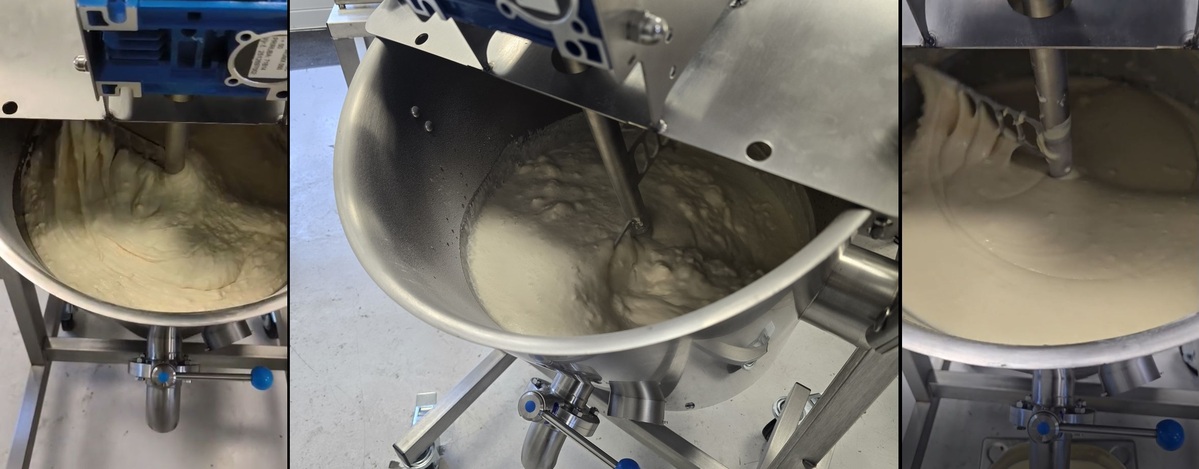
For example, the CookMak Mix cooking kettles and tilting mixers from FTP can utilize several working positions during processing. The vessel can then be fully tilted for fast and convenient unloading through the edge once mixing is complete.
Gravity Mixing During Heating
The principle becomes especially useful when mixing and heating take place at the same time. Products such as caramel, creams, fillings, syrups and other viscous food masses can be difficult to heat uniformly. Product that remains in contact with a heated surface for too long can experience localized overheating, and insufficient circulation can lead to temperature differences within the batch.
Combining tilting, mechanical agitation and scraping (with the use of self adjusting stainless steel scrapers) helps continuously move the product across the heated surface.
In a tilting cooking kettle, the agitator can move the product towards the heated area while gravity assists in its return. Scrapers can additionally serve to remove product from the vessel bottom (and walls optionally), improving contact between the product and the heated surface.
This creates a combination of:
controlled heating + mechanical mixing + gravity-assisted circulation + scraping
which is particularly useful for thermally processing viscous products like caramel.
Where is Gravity-Assisted Mixing Useful?
Gravity-assisted mixing can be useful for processing a diverse range of products, especially those with medium to high viscosity, including:
- caramel and confectionery masses;
- creams and pastry fillings;
- jams and fruit preparations;
- viscous syrups;
- sauces;
- fruit fillings;
- honey-based products;
- thick doughs and batters;
- mashed or semi-solid food products.
The gravity mixing technology can also be useful when ingredients need to be incorporated into an existing viscous mass. Tilting helps bring the product mass toward the active mixing area, as the agitator distributes the ingredients throughout the batch.
Applying Gravity Mixing in our Food Processing Equipment
At FoodTechProcess, we apply this principle in many configurations of our food processing equipment, including our CookMak Mix tilting cooking kettles and tilting mixers.
The vessel is mounted on a tilting mechanism that allows the operator to select the best working position. During mixing, the tilted vessel angle encourages the product to move naturally toward the lowest point, and the agitator continuously lifts it back and redistributes it.
For the FoodTechProcess tilting cooking kettles, the same tilting mechanism provides another major advantage: the vessel can be tilted up to 110° after processing for fast and simple discharge. The FTP cooking kettles are mounted on caster wheel, allowing the vessel to be transferred within the production facility before unloading.
This means the same mechanical feature serves two purposes:
- during processing: tilting assists product circulation and mixing;
- after processing: tilting allows the product to flow out of the vessel by gravity.
This is especially useful for discharging thick products that difficult to pour from a conventional fixed vessel through a small valve.
More Efficient Unloading
Discharge is often overlooked when comparing mixing equipment, but it can have a significant effect on overall production efficiency.
A fixed cooking kettle may require the operator to remove a thick product through a small bottom outlet, manually scrape the vessel, or use additional equipment to transfer the product such as a pump.
With a tilting vessel, the entire working bowl can be rotated toward the discharge position. Gravity then assists the removal of the product from the vessel.
Depending on the equipment configuration and product properties, this can provide very high product recovery compared to stationery vessels, while also reducing manual handling and simplifying cleaning. The same principle that helps the product move during mixing therefore also helps remove it after processing.
Gravity Mixing Is Not Simply About Tilting the Vessel
The efficiency of gravity-assisted mixing depends on more than the tilt angle alone, several factors may influence the result:
- product viscosity and consistency;
- vessel geometry;
- fill level;
- agitator shape and position;
- mixing speed;
- tilt angle;
- product temperature;
- friction between the product and vessel surfaces.
For this reason, simply tilting a conventional mixer does not necessarily produce the same result as a mixing system specifically designed around a tilting system.
The agitator, vessel geometry and tilting mechanism need to work together so that the product is continuously returned to the active mixing zone.
When Does Gravity Mixing Make the Most Sense?
Gravity-assisted mixing becomes particularly worth considering when conventional mixing becomes inefficient due to the product being thick, sticky or difficult to circulate.
It can be especially advantageous when the same equipment must perform several operations—for example:
mixing → heating → processing → tilting → discharge
Instead of using separate equipment for mixing and unloading, a tilting processing vessel can combine these functions into one system. For food manufacturers, this can mean fewer manual handling steps, easier product recovery and a more compact processing setup.