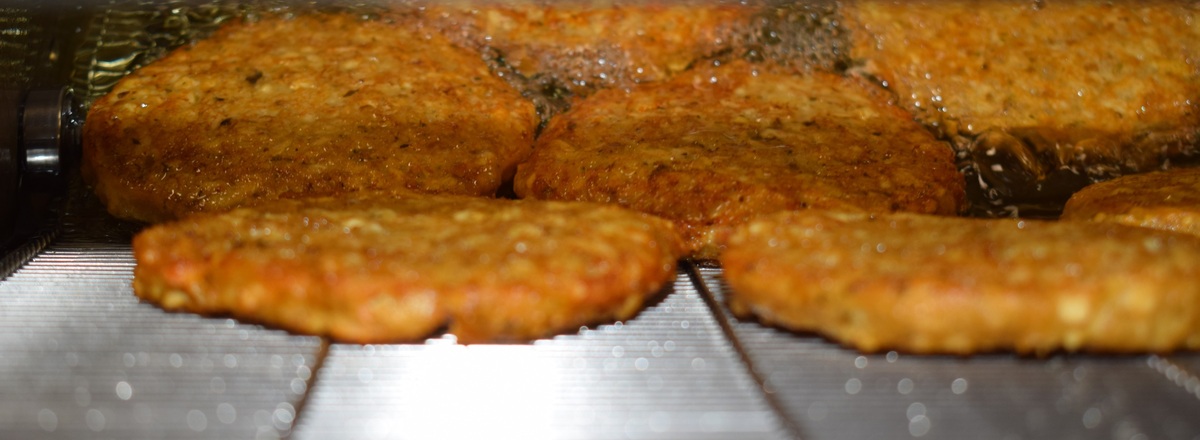
When designing or upgrading a frying system, one of the key questions is how the product will behave in hot oil. This directly affects the choice of conveyor system and has a major impact on product quality, consistency, and process reliability.
Different products react differently during frying. Heavier products typically remain submerged throughout the process. In such cases, a standard conveyor fryer is sufficient, as the product stays fully immersed in oil and is fried evenly without additional control.
However, many products do not behave this way. As moisture inside the product heats up, it turns into steam, and in combination with air inclusions, this can cause the product to rise to the surface. Floating products are more difficult to control and may fry unevenly if not properly guided through the oil.
For these applications, a double conveyor frying system provides the best solution. In this configuration, a second conveyor is positioned above the main conveyor at a fixed distance. This upper conveyor gently holds the product below the oil surface, preventing it from floating and ensuring uniform frying from all sides. Because of this, the double conveyor setup is often the most versatile option and can be used for the widest range of products.
For light and fragile products, such as chips or extruded snacks, product handling becomes just as important as frying itself. These products require careful movement through the fryer to avoid breakage or deformation. A paddle conveyor fryer is designed specifically for this purpose, allowing for gentle and controlled transport of the product as it floats on the surface of the oil.
In addition to the fryer itself, the overall process can be further optimized by integrating supporting equipment. An air cooling conveyor can be used to remove excess surface oil after frying and cool down the product. An oil filtration system helps maintain oil cleanliness after a production cycle, or continuously during operation with an optional hot oil filtration system. These components can be combined into a compact and practical setup, comprising a fryer with cooling and oil filtration, depending on the production requirements.
To better illustrate the system in practice, you can view a video of the continuous fryer in operation with different products tested, available on our YouTube channel.
Understanding how your product behaves during frying is the first step in selecting the right configuration for your business. Making the right choice from the start helps prevent costly mistakes, and ensures consistent production results in the future.