


SLICERS, FLAKERS
Industrial slicers and flakers for consistent food product preparation
Slicers and flakers are used in food processing to reduce raw materials into pieces of a defined thickness, shape or size. They prepare ingredients for further operations such as frying, drying, roasting, freezing, mixing, cooking or packaging.
Although both types of equipment reduce product size, they work in different ways. Slicers cut products into relatively regular pieces using blades or cutting assemblies, while flakers produce thin, flat fragments from suitable materials. The appropriate machine depends on the physical properties of the raw material and the required shape of the finished product.
Consistent cutting is important not only for product appearance but also for processing performance. When pieces have similar dimensions, they tend to behave more uniformly during subsequent heat treatment, drying, frying or other production stages.
Slicing and flaking: how the processes differ
Slicing
Slicing machines use sharp blades, rotating cutting elements or other specialized cutting mechanisms to divide products into pieces of a specified thickness. Depending on the machine design, products can be cut into round slices, strips or other shapes.
Slice thickness is an important processing parameter. It influences the product's appearance, portion size and behaviour during subsequent operations. For example, evenly sliced potatoes are easier to fry or dry consistently, while uniform vegetable slices help achieve more predictable cooking results.
Flaking
Flaking machines reduce suitable raw materials into thin, flat pieces. Depending on the equipment, this can be achieved using cutting, crushing or roller-based mechanisms. Flakes are generally used as ingredients in further food production rather than as conventional sliced portions.
Flake thickness, dimensions and structure depend on the raw material, its condition and the machine configuration. These characteristics are important when flakes need to be mixed with other ingredients, incorporated into formulations or processed further.
Applications in food processing
Slicers and flakers are used in different food production sectors, with machine selection determined by the product and the required cutting result.
Fruit and vegetable processing
Slicers are used to prepare fruits and vegetables for further processing. Typical operations include cutting potatoes, carrots, beetroot and other vegetables into slices for frying, drying, roasting or inclusion in prepared food products. Fruit slicing can also be used for drying, snack production and ingredient preparation, provided the machine is designed for the particular fruit.
Potato and snack production
Uniform slicing is especially important in potato chip and vegetable snack manufacturing. Consistent slice thickness helps achieve more predictable frying or drying times and contributes to a uniform finished product. The cutting process must also minimize unnecessary damage and product waste.
Frozen product processing
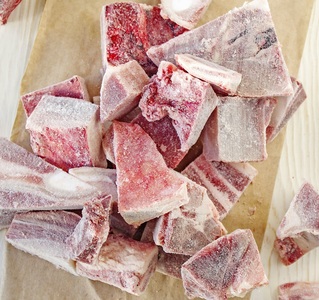
Specialized flakers can be used to reduce frozen raw materials or blocks such as frozen meat into smaller, thinner pieces. This makes the product easier to portion, mix or incorporate into subsequent processing stages. Equipment intended for frozen products must be designed to withstand the mechanical demands of processing material at low temperatures.
Food ingredient preparation
Flakes and slices can be used as ingredients in a wide range of food products. Their dimensions influence how easily they can be blended, hydrated, cooked or incorporated into a finished formulation.
Factors affecting cutting quality
The quality of the finished slices or flakes depends on more than the blade or roller arrangement. Raw material characteristics and operating conditions also play an important role.
- Product condition: Hardness, firmness, moisture content, temperature and maturity can affect cutting resistance and the quality of the cut surface.
- Cutting thickness: The required dimensions determine the appropriate cutting mechanism and machine adjustment.
- Blade condition: Sharp, properly maintained cutting elements help produce cleaner cuts and reduce crushing or tearing.
- Feeding and product positioning: Consistent product feeding helps maintain uniform dimensions and stable machine operation.
- Processing capacity: The machine must be matched to the required throughput without compromising cutting quality.
- Product waste: The cutting process should minimize unwanted fragments, breakage and losses of usable raw material.
Integrating slicers and flakers into production lines
Slicing and flaking are often intermediate operations within a larger production process. A slicer may be installed after washing, peeling or trimming equipment, with the cut product transferred to a fryer, dryer, blancher or other processing machine.
Flakers may be used before mixing, cooking or further ingredient preparation, depending on the material being processed. Conveyors and feeding systems can help maintain a continuous product flow between operations and reduce manual handling.
The overall line configuration should take into account the required product dimensions, production capacity, transfer arrangements and cleaning requirements. Particular attention should be paid to the handling of fragile or irregularly shaped materials, as excessive mechanical stress can increase breakage and reduce product quality.
FoodTechProcess offers slicers and flakers for food processing applications. Selecting suitable equipment requires matching the cutting method and machine configuration to the raw material, required slice or flake dimensions and the next stage of production.
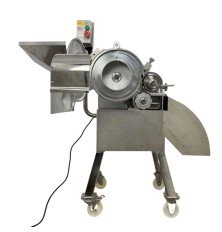
The high-performance slicing and dicing machine can function as a standalone unit or be integrated into a production line.
- Can process large products - sweet potato, lettuce, root vegetables
- Large selection of replaceable knives - different sizes of the final product
- Material: Stainless steel
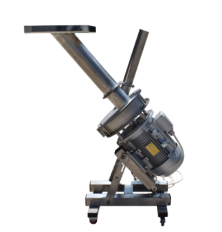
The cutting machine is designed for slicing, shredding and grating fruits and vegetables.
- Productivity: 500 kg/h/
- Material: Stainless steel
- Principle of operation: Continuous mode
- Dimensions, mm: 602x488x1581
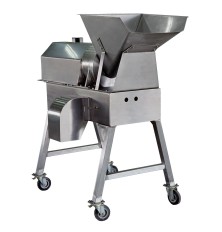
The cutter is designed for cutting into cubes, stripes or slices.
- Material: Stainless steel
- Engine power, kW: 2,2
- Principle of operation: Continuous mode
- Voltage: 380-400V
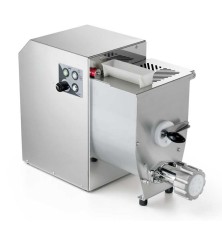
SIPM 10 liter pasta mixer is designed for medium size commercial operations, ideal for medium-size restaurants to produce any kind of pasta such as spaghetti, taglia pasta, cannelloni, macaroni, conchiglie, rigatoni, penne and many others. The price includes a pasta cutter.
- Productivity: 8,4 kg/h
- Material: Stainless steel
- Engine power, kW: 0,75
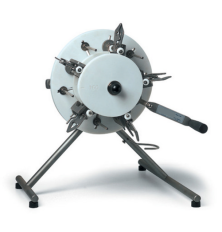
Manual cutter for cutting potions of fresh cured meats with interchangeable eccentrics to obtain different sausage lengths up to a maximum of 280 mm. Works with any type of casing.
- Productivity: 100-400 psc/h
- Material: Stainless steel
- Principle of operation: Continuous mode
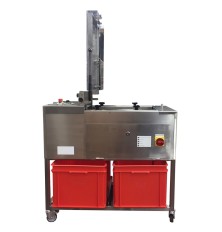
Chocolate flaking machine for automatically differentiating two blocks of couverture each time. The flakes are collected in plastic baking for food. The machine comes with two plastic bins.
- Productivity: 30 kg/h
- Material: Stainless steel
- Voltage: 220-230V
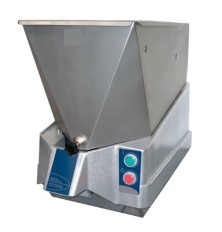
Cutter for french fries with an automatic hopper. Approx. 25 kg of French fries 12mm per minute. Cutting blocks are ordered separately.
- Productivity: 1500 kg/h/
- Material: Stainless steel
- Engine power, kW: 0,37
- Dimensions, mm: 360x670x560
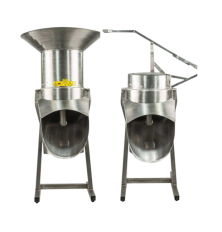
Compact size vegetable/cabbage cutting machine, that is intended for vegetable shredding, slicing, grating and julienne stick cutting.
The price depends on the production capacity.
- Productivity: 1000 kg/h/
- Material: Stainless steel
- Principle of operation: Continuous mode
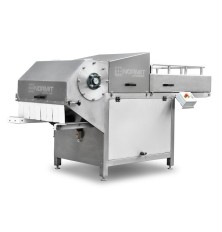
The block cutter is designed for chopping frozen blocks of meat, fish, poultry, meat by-products, juice, butter or margarine without prior defrosting. This is a convenient and quick method of preparing the products for further processing, which saves time and reduces the likelihood of product contamination.
- Efficiently slices the product into thin layers while preserving its texture
- Safe pneumatic feeding of the product into the grinding section
- Special fixation system for the product container during unloading
- Low product losses during processing
- A powerful blade drive
- Material: Stainless steel
- Principle of operation: Continuous mode
- Country of origin: Slovakia
- Working Area Width: 600 mm
- Total power, kW: 11
- Voltage: 380-400V
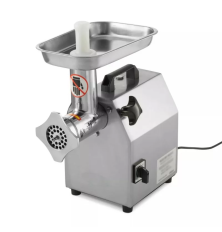
The industrial meat grinder is made out of food-grade stainless steel. The kit includes various accessories such as a sausage attachment and an attachment with two cross blades. The productivity of the meat grinder is around 120 kg of minced meat per hour.
- Compact
- Professional
- With anti-slip rubber feet
- Stainless steel housing
- Productivity: 120 kg/h
- Material: Stainless steel
- Operation mode: Automatic
- Principle of operation: Continuous mode
- Total power, kW: 0,75
- Voltage: 220-230V
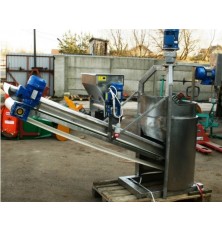
The CAF 65 cabbage shredder is designed for large processing plants, for a daily production of about 60 tons.
- Engine power, kW: 2,2
- Principle of operation: Continuous mode
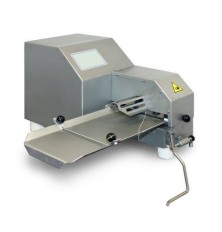
Semi-automatic tying machines are designed for tying sausages and other meat products. Suitable for meat producers or small butchers.
- Material: Stainless steel
- Weight: 42
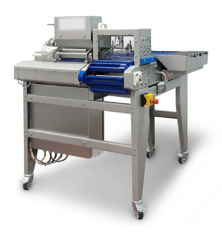
Fully automatic machine for making kebab and brochettes by skewering meat on a stick with a maximum production capacity of 1500 pieces per hour.
- Productivity: 1500 psc/h
- Principle of operation: Continuous mode
- Weight: 120
- Voltage: 220-230V
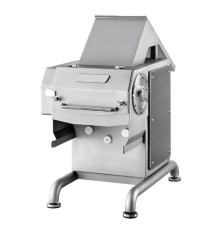
We offer different types and capacities of meat flakers.
- Material: Stainless steel
- Engine power, kW: 5,5
- Operation mode: Semi-automatic
- Country of origin: EU
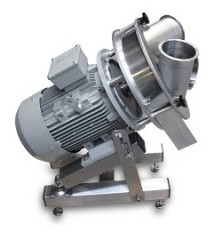
Vegetable cutter with adjustable cutting thickness, blades very easy to replace which makes them cost-effective.
- Productivity: 500 kg/h/
- Material: Stainless steel
- Principle of operation: Continuous mode
- Country of origin: Slovakia
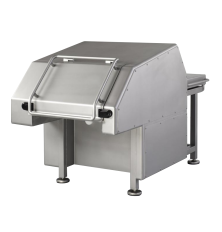
The meat flaker is an automatic machine for cutting frozen blocks of meat into slices.
- Productivity: 2500 kg/h
- Material: Stainless steel
- Engine power, kW: 9,2
- Principle of operation: Continuous mode