PUMPS
Food processing pumps for transferring liquids, sauces and viscous products
Pumps are essential equipment in food production, where liquids and semi-liquid products must be transferred between processing stages, storage vessels and filling systems. They move ingredients and finished products through pipelines, help maintain a continuous production flow and reduce the need for manual handling.
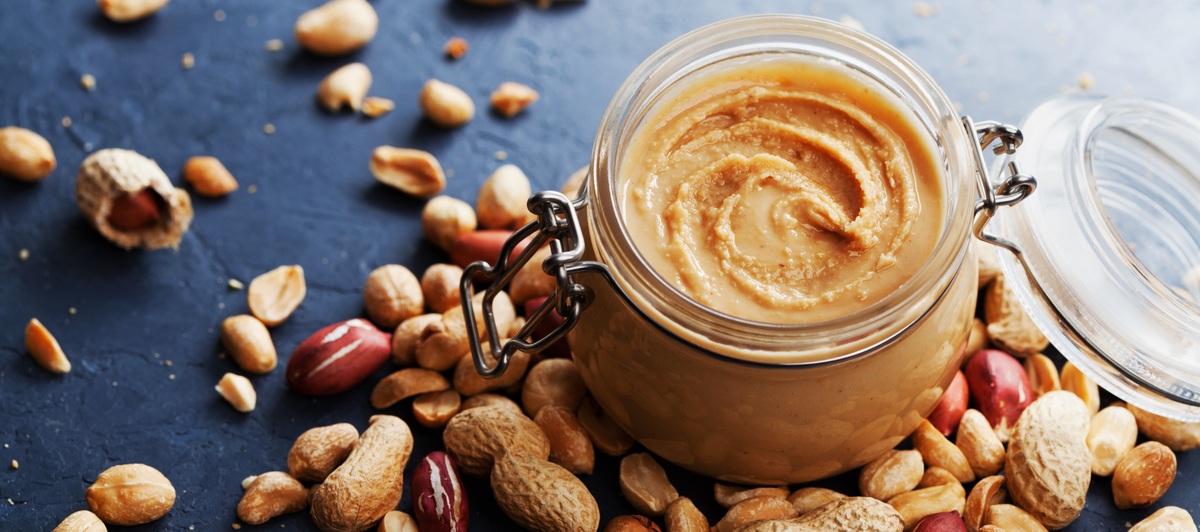
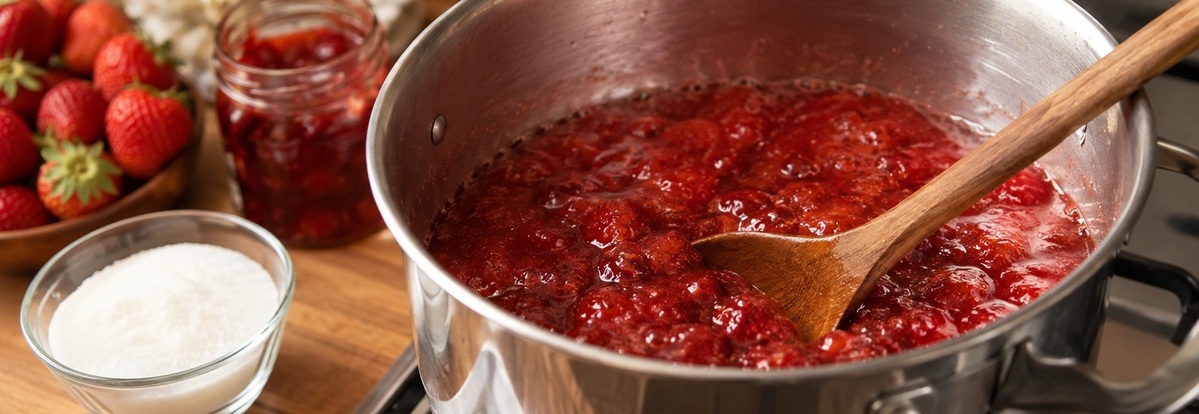
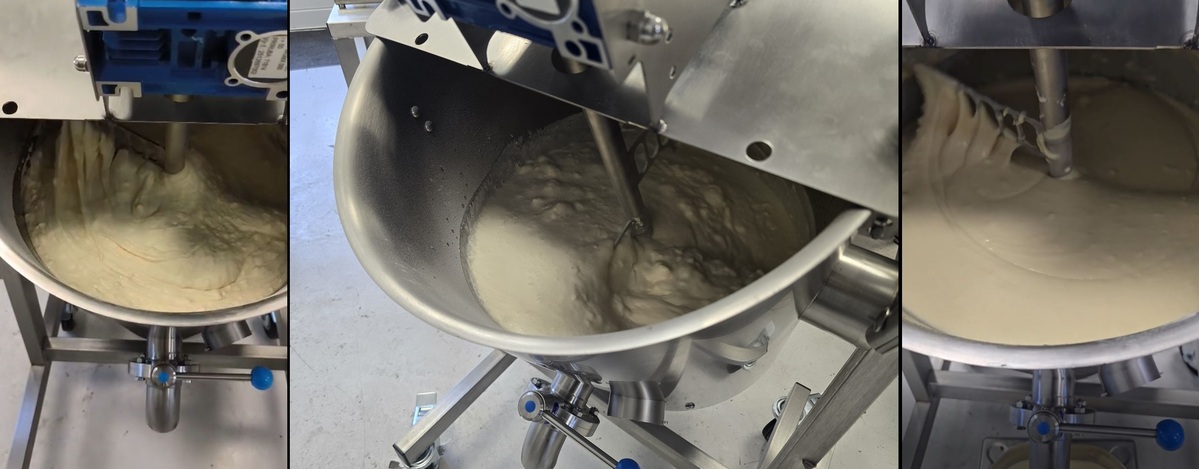
The range of products handled by food processing pumps is wide. It includes water, milk, juices, oils and syrups, as well as thicker materials such as sauces, creams, pastes and fruit preparations. Some products contain suspended particles or solid inclusions, while others are sensitive to mechanical stress and must be transferred without significantly changing their texture.
For this reason, pump selection is not simply a matter of choosing the required flow rate. The product's viscosity, temperature, particle content, sensitivity to shear, required pressure and transfer distance all influence which pump design is suitable.
How food processing pumps work
A pump creates the pressure difference needed to move a product through a pipe or processing system. However, different pump designs generate flow in different ways, and this determines how they handle particular food products.
The two main operating groups are centrifugal pumps and positive-displacement pumps.
Centrifugal pumps use a rotating impeller to accelerate the liquid. The resulting kinetic energy is converted into pressure, moving the product through the outlet. They are generally suited to relatively low-viscosity liquids and applications requiring continuous flow.
Positive-displacement pumps move a defined volume of product with each operating cycle or rotation. They are often better suited to viscous liquids, pastes and products that require more consistent flow despite changes in viscosity or discharge pressure. Depending on the design, they can also handle products containing particles or inclusions.
The distinction is important: a pump that performs well with water or juice may be unsuitable for a thick sauce or a product containing delicate pieces of fruit or vegetables.
Types of pumps used in food production
Centrifugal pumps
Centrifugal pumps are commonly used for transferring low-viscosity liquids at relatively high flow rates. Their rotating impeller creates the movement of liquid, making them suitable for water, milk, juices, liquid ingredients and other products with similar flow characteristics.
They are often used for circulation, transfer between tanks and supplying liquid to processing equipment. Their performance depends on the product's viscosity, temperature, pipework and required operating pressure. Standard centrifugal designs are generally less suitable for very thick products or liquids containing large solid pieces.
Gear pumps
Gear pumps are positive-displacement pumps that use rotating gears to move product from the inlet to the outlet. They provide a relatively steady flow and are suitable for certain viscous liquids, oils, syrups and other products that can be handled by the particular pump design.
Their suitability depends on clearances, product lubricity, viscosity and the presence of abrasive particles or larger inclusions. They are generally not the first choice for products containing delicate or large solid pieces.
Screw pumps
Screw pumps use one or more rotating screws to move product along the pumping chamber. They can provide smooth, relatively low-pulsation transfer and are used for viscous products and applications where a steady flow is important.
Depending on their construction, screw pumps can handle products such as creams, sauces, pastes and other semi-liquid food materials. Some designs are also suitable for products containing suspended particles. The number and arrangement of screws, operating speed and pump geometry determine the actual handling capabilities.
Rotary positive-displacement pumps
Rotary pumps use rotating elements to transport product through the pump chamber. This is a broader group of equipment that can include gear, lobe, vane and other specialized designs. Their common feature is that product is moved by the displacement created by rotating components rather than by centrifugal acceleration.
Different rotary designs have different limitations. Some are suitable for viscous products, while others are selected for controlled flow, compact construction or particular product characteristics. The choice should take into account the required flow, pressure, cleaning method and the presence of particles.
Vane pumps
Vane pumps use sliding vanes mounted in a rotating rotor. As the rotor turns, the vanes form changing chambers that draw in and discharge the product. They can provide controlled transfer of suitable liquids, but their application in food production depends on the pump's materials, clearances and compatibility with the product.
They should not automatically be considered suitable for products containing large particles or abrasive ingredients.
Impeller pumps
Flexible-impeller and other specialized impeller pumps use a rotating element to move liquid through the pump chamber. Certain designs can handle liquids containing small suspended solids and are used where a more adaptable pumping action is required.
The ability to handle particles depends on the impeller material, chamber design, particle size and product characteristics. The term impeller pump covers different constructions, so suitability should be checked against the actual equipment specification.
Choosing a pump for your product
The most important factor in pump selection is the product being transferred. Viscosity, particle size, temperature and sensitivity to mechanical action can all affect pumping performance.
- Low-viscosity liquids such as water, milk and many juices are commonly transferred using centrifugal pumps. These are suitable where a relatively high and continuous flow rate is required.
- Viscous products such as syrups, creams, pastes and thick sauces often require positive-displacement pumps. Gear, screw and other rotary designs can be considered depending on the product and required operating conditions.
- Products containing solid inclusions require particular attention to pump geometry and internal clearances. Fruit pieces, vegetable particles, herbs and other inclusions must be able to pass through the pump without becoming trapped, crushed or damaged. A pump designed for smooth liquids may not be suitable.
- Shear-sensitive products may require a pump that transfers the product at an appropriate speed and with limited mechanical stress. This is especially relevant for products where maintaining the original particle structure or texture is important.
Applications of pumps in the food industry
Pumps are used throughout food production, from receiving and preparing raw ingredients to transferring finished products for filling and packaging.
- Beverage production: Transfer of water, juices, syrups, concentrates and other liquid ingredients between storage tanks, mixing vessels, filtration systems and filling equipment.
- Dairy processing: Movement of milk, cream, liquid dairy ingredients and other suitable dairy products through processing and storage systems.
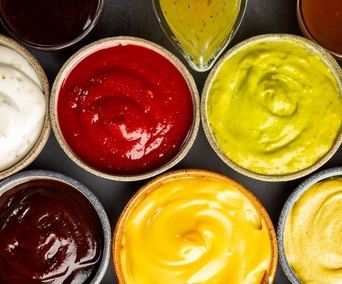
- Sauces and condiments: Transfer of dressings, ketchup, mayonnaise, marinades, liquid seasonings and thicker sauces. Pump selection depends particularly on viscosity and whether the product contains particles.
- Fruit and vegetable processing: Handling of juices, purées, concentrates and prepared fruit or vegetable mixtures, with the pump selected according to the consistency and solid content of the product.
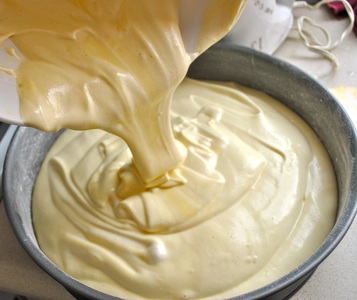
- Bakery and confectionery: Transfer of syrups, fillings, creams, chocolate-based mixtures and other ingredients where the product's viscosity and temperature must be considered.
- Meat processing: Pumping of brines, marinades, oils and other liquid ingredients used in meat preparation and processing.
Hygienic design and integration into production lines
Food processing pumps must be designed for contact with food products and for the cleaning procedures required by the production environment. Product-contact materials, seals, surface finishes and internal construction all influence hygiene and maintenance.
The pump should also be compatible with the cleaning method used in the facility. Some systems are designed for clean-in-place (CIP) procedures, while others may require dismantling or manual cleaning. CIP suitability depends on the complete pump construction and installation, not simply on the fact that the equipment is used in food production.
Pumps are commonly installed between tanks, mixers, cooking vessels, pasteurizers, filters, filling machines and other processing equipment. Correct sizing and installation help avoid excessive pressure losses, unnecessary product recirculation and unstable flow. In some applications, a variable-speed drive is useful for adjusting transfer capacity to match the requirements of the production line.
Selecting the right pump
Before choosing a pump, it is important to define the operating conditions and the characteristics of the product. The main selection factors include:
- Product viscosity: Whether the pump will handle a thin liquid, a viscous sauce or a paste.
- Solid content: The size, concentration and fragility of any suspended particles or inclusions.
- Required flow rate: The volume of product that must be transferred within a given time.
- Operating pressure: The pressure needed to overcome pipework resistance and supply downstream equipment.
- Temperature: The product's operating temperature and any temperature changes during transfer.
- Product sensitivity: Whether mechanical stress, shear or changes in particle structure must be minimized.
- Hygiene and cleaning: Product-contact materials, seal design, drainage and compatibility with the required cleaning procedure.
- Installation requirements: Available space, connection sizes, pipe layout, control system and integration with other equipment.
FoodTechProcess offers pumps for transferring liquids and semi-liquid products in food processing applications. The appropriate solution depends on the product being handled and the requirements of the production process, from simple liquid transfer to the pumping of more viscous food mixtures.
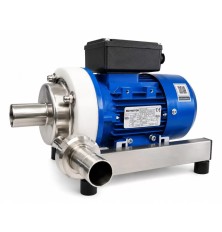
The stainless steel impeller milk pump is designed for hygienic and efficient transfer and circulation of milk and other low-viscosity liquid dairy products.
- Suitable for milk and other liquid dairy products
- Two motor options: 0.55 kW and 1.1 kW
- Pumping capacity of approximately 14 m³/h and 20 m³/h respectively
- 40 mm inlet for both versions
- Material: Stainless steel
- Engine power, kW: 0,55/ 1,1
- Principle of operation: Continuous mode
- Voltage: 230 V/ 380-400V
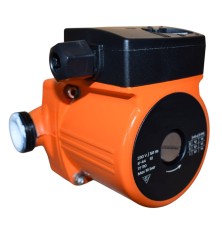
The circulation pump for the heating system is a mandatory component for the operation of a flow-through heating system used for heating the water serving as a heat transfer medium inside the duplicator of industrial cooking boilers, mixers, reactors, and vacuum evaporators in food production. It is selected based on the required parameters of the heating system (volume). Our specialists will be happy to assist you in selecting the appropriate pump if you provide the technical specification requirements. This pump is an essential additional component for the flow-through water heater up to 110°C.
- It can be used to circulate water at temperatures up to 110° C
- High efficiency with low power consumption
- Also suitable for central heating systems, heated floors and even for solar systems
- Small connections allow the use of flexible pipes with a smaller diameter
- Type of equipment: Optional equipment
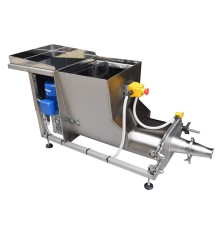
The screw pump is used for transferring "un-pumpable" products. A great choice for those who work with hard to move liquids and need to move them as quickly as possible.
- Material: Stainless steel
- Voltage: 380-400V
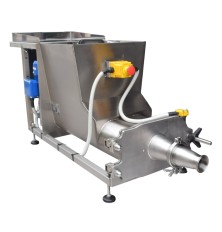
Twin-screw extruder is designed for effective extruding, homogenization, pumping over of plastic masses (butter, margarine, honey, curd products, confectionery mixtures), and forming it into bars and rolls.
Product consistency: The extruder is designed for firm but plastic product masses, typically at a temperature of around 12 °C. Suitable products include butter, margarine, and other similar plastic food masses.
- Productivity: 400 kg/h
- Material: Stainless steel
- Principle of operation: Continuous mode
- Country of origin: Slovakia
- Weight: 115 kg
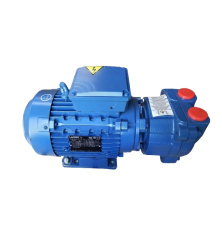
This pump is a monoblock single-stage liquid ring vacuum pump suitable for low, medium, and high vacuum applications. It is an economical pump with exceptional performance and reliability.
- Productivity: 52 m3/h
- Principle of operation: Continuous mode
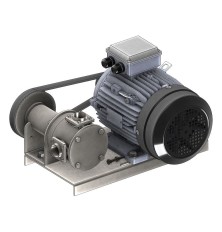
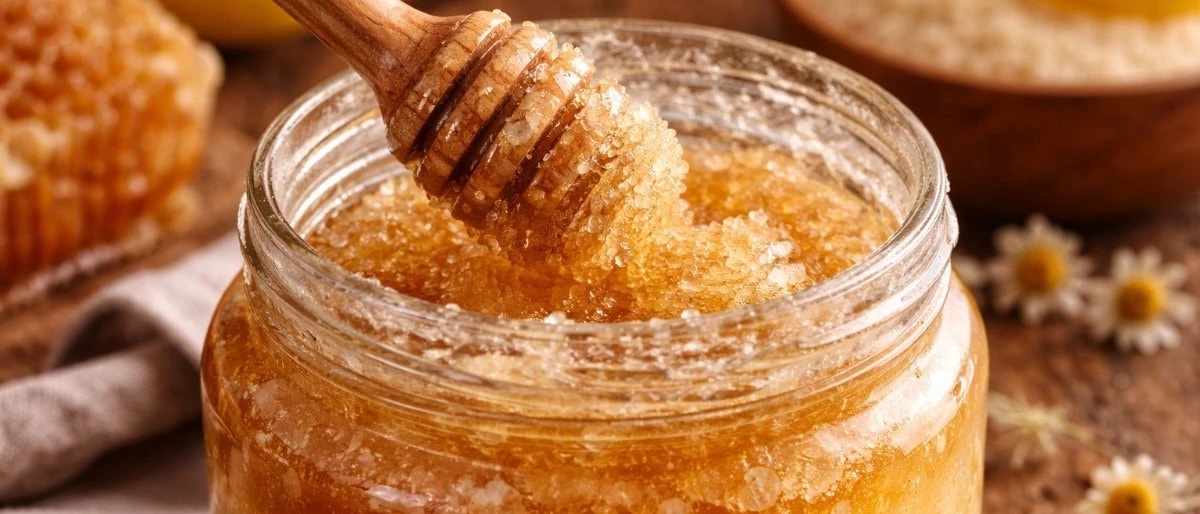
Vane pumps are used for pumping high viscosity products such as syrups, honey, mayonnaise, sauces, cream and many other products.
- Material: Stainless steel
- Engine power, kW: 2,2
- Type of pump: rotary vane
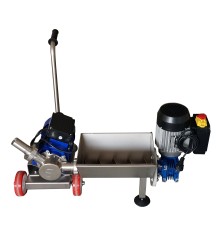
This system is specifically designed for facilitating the direct transfer of pulp to a press.
- Productivity: 2000 kg/h
- Engine power, kW: 0,37
- Weight: 28
- Type of pump: Volumetric, self-priming
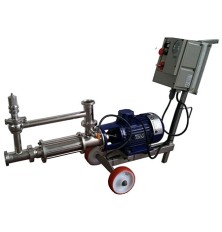
The high-performance screw pump is used for pumping both thick and viscous food products, as well as various masses containing pieces or solid inclusions such as in the cosmetics, cosmetology, and other industries.
- High performance
- All parts in contact with the product are made out of AISI304
- Does not damage products containing solid pieces
- Additional options: by-pass
- Material: Stainless steel
- Engine power, kW: 1,1/ 1,5 / 3
- Principle of operation: Continuous mode
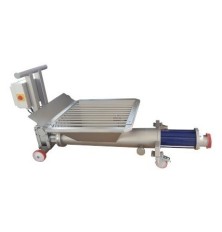
Progressive cavity pumps are used to transfer low and high viscosity products as well as products containing soft particles. They are available in three sizes.
- Material: Stainless steel
- Engine power, kW: 3/ 4
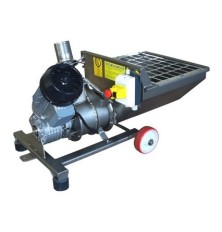
Elliptical rotor pump (three power range models available).
- Material: Stainless steel
- Engine power, kW: 1,8/ 4/ 5,5
- Principle of operation: Continuous mode
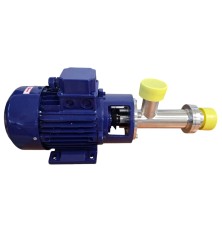
The pump provides a delicate straight-streaming pumping of a wide range of liquids with or without solid fragments with viscosity up to 150 Pa.s.
- Material: Stainless steel
- Engine power, kW: 1,1
- Principle of operation: Continuous mode
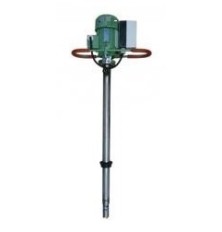
The portable vertical pump is designed for pumping fluent or viscous liquids in the range from 1-2300 m2/s at a temperature of around 25°C. The pump cannot be used in potentially explosive atmospheres.
- Material: Stainless steel
- Engine power, kW: 0,25
- Voltage: 380-400V
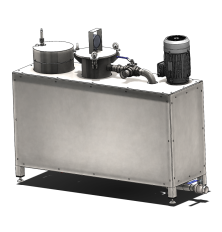
Electric continuous flow heaters in different designs and performance parameters.
- Heating: Electric
- Material: Stainless steel
- Country of origin: Slovakia
- Type of pump: sealless pump
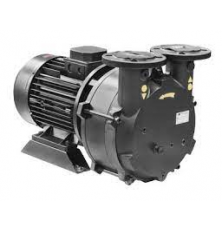
The single-stage vacuum pumps are versatile, offering a wide range of applications when it comes to transporting liquids due to their simplicity, reliability, and robustness. The device operates with minimal vibrations, and its noise levels do not exceed the prescribed standards. Additionally, it ensures oil-free operation.
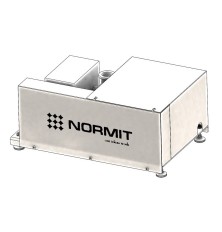
The lobe rotary pumps are designed for pumping both liquid and thick products. We offer lobe pumps in 2 versions with 1.5 kW is a standard for milk, cream and similar products, and 3 kW is for dense low-flow products such as honey, pastes, cottage cheese etc.
- Engine power, kW: 1,5 / 3
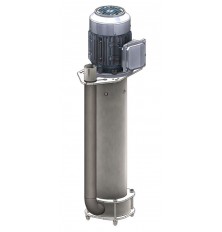
Designed for pumping hot thermal oil in frying circulation and filtration systems, for oil loading and unloading, in "hot" continuous oil filtration systems with a maximum temperature of up to 200 degrees.
- Material: Stainless steel
- Engine power, kW: 0,55
- Country of origin: Slovakia
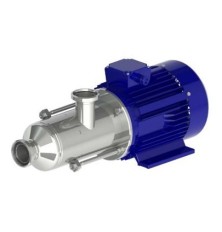
The homogenizer is designed to homogenize, mix and disintegrate / grind different fluids and components into small particles.
- Principle of operation: Continuous mode
- Country of origin: Slovakia
- Voltage: 380-400V
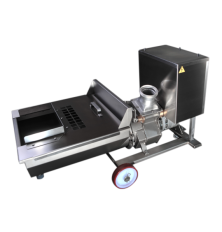
The fruit mash pump is designed for efficiently transporting mashed fruits from a crusher to a press for extracting juice.
- Productivity: 6000 kg/h
- Material: Stainless steel
- Engine power, kW: 1,85
- Voltage: 380-400V
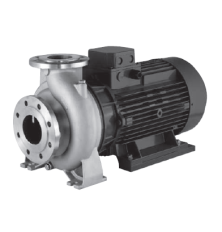
We sell many types of pumps for many applications and processes. For a free consultation, contact us by sending a request and we will try to recommend the right type of pump for your production.
- Material: Stainless steel
- Type of pump: Centrifugal Stainless Steel Pump
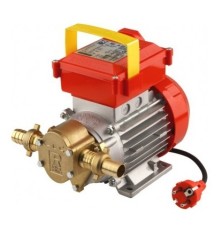
We offer different types of pumps for different processes.
- Engine power, kW: 0,37
- Dimensions, mm: 230x190x120
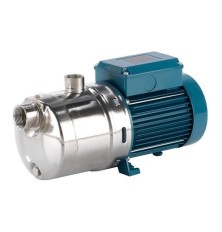
We offer different types of pumps for different applications.
- Principle of operation: Continuous mode
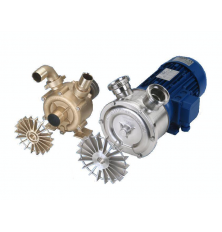
We offer a wide variety of different pumps for all kinds of liquids, semi-liquid products in various applications.
- Principle of operation: Continuous mode
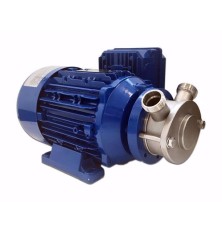
Monoblock pumps with an integrated frequency converter. We offer many different types of pumps, if you need any advice on which pump to choose, feel free to send us the request.
- Principle of operation: Continuous mode
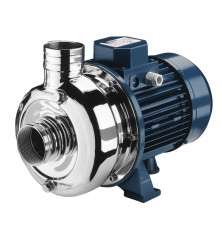
Centrifugal impeller pumps are ideal for various industrial applications such as food processing, manufacturing, washing and surface treatment of metal pieces, boxes, containers, glass jars and vessels. These pumps are also suitable for dishwashers, bottle washing lines, painting processes, and pumping liquids into various chambers.
- Principle of operation: Continuous mode
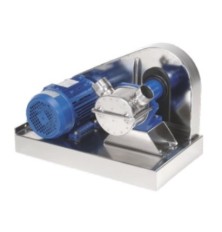
Stainless steel low-speed rotary pumps with a flexible impeller; We offer two versions. On base or trolley.
- Principle of operation: Continuous mode
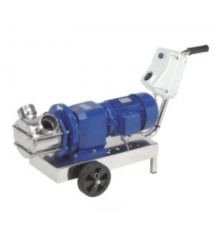
Stainless steel low-speed rotary pumps with flexible impeller; particularly suitable for transfer of delicate, fragile and viscous fluids, also with solid parts in suspension.
- Principle of operation: Continuous mode
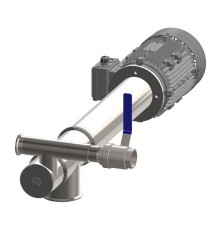
One of advantages of this glandless pump is very high durability and efficiency in operation in very demanding conditions. We offer glandless pump with different power variations.
- Principle of operation: Continuous mode
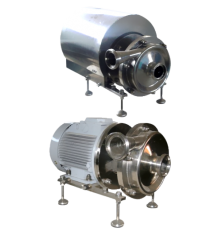
Centrifugal pump designed for pumping low viscosity food and aggressive liquids.
- Principle of operation: Continuous mode