


EVAPORATORS
Industrial vacuum evaporators for concentrating liquid food products
Evaporators are used in food processing to remove part of the water or another volatile component from a liquid product, increasing its concentration and reducing its volume. This operation is important in the production of condensed milk, concentrated dairy products, syrups, fruit preparations, plant extracts and many other food ingredients.
Vacuum evaporators carry out this process under pressure below atmospheric pressure. Reducing the pressure lowers the boiling temperature of the liquid, allowing water to evaporate at a lower temperature than under normal atmospheric conditions. This is particularly important when processing heat-sensitive products, where excessive thermal exposure can affect flavour, colour, texture and nutritional properties.
The choice of evaporator depends on the product's viscosity, heat sensitivity, required concentration, processing capacity and the amount of water to be removed. Different designs also vary in the way the product circulates, receives heat and moves through the evaporation chamber.
How vacuum evaporation works
In a conventional evaporation process, heat is supplied to the liquid until part of its water content evaporates. The resulting vapour is removed, while the remaining liquid becomes progressively more concentrated.
In vacuum evaporation, the same principle is applied at reduced pressure. Because the boiling point is lower, the product can be concentrated at a lower operating temperature. This helps limit heat-related changes, particularly in products containing proteins, sugars, aromas and other temperature-sensitive components.
A typical vacuum evaporation system includes a processing vessel or evaporation chamber, a heating system, a vacuum system, a vapour outlet, a condenser and a collection arrangement. Depending on the design, it may also include a circulation pump, external heat exchanger, product feeding system and automatic controls.
The process generally involves the following stages:
- Product feeding: The liquid product is introduced into the evaporation system. Depending on the equipment, operation can be carried out in batches or continuously.
- Heating: Heat is transferred to the product, commonly through a heating jacket or heat exchanger. Steam is frequently used as the heating medium, although some systems use hot or superheated water.
- Evaporation under vacuum: Reduced pressure allows the liquid to boil at a lower temperature. Part of the water evaporates and passes into the vapour system.
- Vapour condensation: The generated vapour is directed to a condenser, where it is cooled and converted into liquid.
- Concentrate discharge: The concentrated product is discharged when the required concentration has been reached, or transferred to the next stage in a continuous process.
The operating pressure, product temperature, heating intensity, circulation rate and residence time all influence the final result.
Construction and operating principles
Vacuum evaporators are designed for batch processing and can differ in their construction, particularly in the way heat is transferred to the product and how the product is circulated during evaporation. In most designs, the product is heated indirectly through a heating jacket (dimple jacket) surrounding the vessel. Other configurations use a circulation system in which the product passes through a dedicated heating circuit before returning to the vacuum chamber.
Batch vacuum evaporators process a defined quantity of product in a single vessel. The product is loaded, heated and concentrated under vacuum until the target concentration is achieved. The finished concentrate is then discharged before the next batch begins.
Main construction types
Single-body vacuum evaporators are available in several configurations, each with different heat-transfer and product-handling characteristics.
- Vessel-type evaporators with a heating jacket and condenser: The product is heated directly through the vessel wall and concentrated inside the processing chamber. This is a relatively straightforward configuration for batch evaporation.
- Natural-circulation evaporators with an external heat exchanger: Product movement through the heating circuit is driven by differences in density and temperature, without relying primarily on a circulation pump.
- Forced-circulation evaporators with an external heat exchanger: A pump moves the product through the heat exchanger and back into the evaporation chamber. Forced circulation improves control over product movement and heat transfer and can be useful for products with higher viscosity or a tendency to deposit on heating surfaces.
- Film evaporators: The product is distributed as a thin film over a heated surface, reducing the thickness of the liquid layer through which heat must pass. These systems are used where rapid heat transfer and controlled product exposure are important.
- Centrifugal-film evaporators: Rotating elements distribute the product into a thin film across the heated surface. This arrangement supports rapid heat transfer and is used in specialised concentration processes.
Some modern systems combine features of different evaporator designs to suit particular products and processing requirements.
Heating systems and circulation-type vacuum evaporators
In conventional vacuum evaporation systems, steam is commonly used as the heating medium. It is supplied to the vessel jacket or an external heat exchanger, transferring energy to the product through a heating surface. Steam is widely used because of its effective heat-transfer characteristics and suitability for industrial food processing.
Smaller vessel-type systems may also use hot or superheated water as the heating medium, depending on their design and required operating temperatures.
Another approach is used in circulation-type vacuum evaporators, where the product is heated as it passes through a circulation circuit. In certain configurations, heating is applied directly to the product flow rather than through a conventional external heating medium. The heated product then enters the vacuum chamber, where a rapid reduction in pressure causes part of the liquid to evaporate. This is known as flash evaporation.
The combination of rapid heating and flash evaporation can reduce the time the product spends at elevated temperatures. The process also produces a cooling effect as part of the liquid evaporates under reduced pressure. These characteristics can be advantageous when concentrating products sensitive to prolonged heating.
The circulation-type vacuum evaporator combines forced product circulation with vacuum evaporation. Depending on the configuration, the process can also incorporate a rapid heating and cooling sequence similar in principle to flash pasteurization. Actual thermal treatment and product quality depend on the operating parameters and the characteristics of the product.
Applications in food processing
Vacuum evaporation is widely used in dairy processing. Milk, cream and whey can be concentrated to reduce their water content before further processing or packaging. It is also used in the production of sweetened and unsweetened condensed milk. When processing dairy products, temperature and residence time must be controlled to limit undesirable changes to milk proteins and other components.
In confectionery and syrup production, vacuum evaporation allows sugar-containing liquids to be concentrated at reduced temperatures. This can help limit excessive browning, caramelisation and other heat-related changes, supporting better control over colour, flavour and consistency.
Other applications include the concentration of fruit and vegetable preparations, plant extracts, pekmez, food additives and tinctures. The suitability of a particular evaporator depends on the product's viscosity, solids content, heat sensitivity and required final concentration.
Vacuum evaporation equipment and production lines
FoodTechProcess offers conventional vacuum evaporators for concentrating milk, syrups, whey and other liquid food products, as well as specialised equipment for particular processing applications.
The range also includes production lines for sweetened and unsweetened condensed milk, combining evaporation with the other operations required for manufacturing the finished product.
For specialised products such as pekmez, food additives and tinctures, the equipment configuration must be selected according to the raw material and the required processing conditions. In these applications, vacuum operation can be particularly useful when concentration at lower temperatures is desirable.
Selecting a suitable vacuum evaporator
The most important selection criteria are the type of product, its initial and target solids content, viscosity and sensitivity to heat. These properties determine the appropriate evaporation method, heating arrangement and circulation system.
Production capacity and the required amount of water removal must also be considered. Batch systems offer flexibility for different products and smaller production volumes, while continuous and multi-stage configurations are designed for more sustained processing. Other relevant factors include operating pressure, heating capacity, condenser performance, product residence time, cleaning requirements and the level of automation.
The right evaporator should be matched not only to the required output but also to the characteristics of the product throughout concentration. This helps achieve the target solids content while maintaining control over product quality and process efficiency.
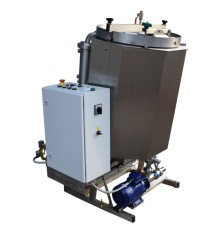
Vacuum evaporator with remote circulation using a heat exchanger is one of the most efficient evaporation methods. This evaporation system is suitable for boiling and concentrating heat-sensitive products such as milk, cream, etc.
- No mixing device required, the product has forced circulation!
- Modular system: possibility to choose the vacuum generator, power and heat exchanger type
- Inclined design and bottom valve for 100% product discharge without losses and blind spots
- Insulated upper hatch of the unit for heat retention and safety
- Tangential product inlet into the vacuum vessel for guaranteed evaporation in a thin layer
- Material: Stainless steel
- Volume: 50l/ 100l/ 300l
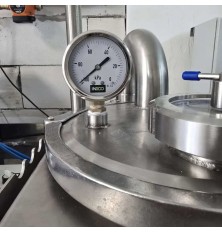
Multifunctional vacuum pilot unit MINI5 - is ideal for cooking, drying, concentrating, mixing and much more. Suitable for laboratories and experiments.
- Processing heat-sensitive products at lower temperatures
- Ideal for making creamed honey
- Possibility of vacuum drying honey
- Material: Stainless steel
- Engine power, kW: 0,12
- Country of origin: Slovakia
- Volume: 5l
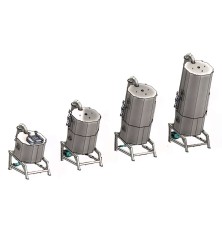
Vacuum evaporators are designed for concentration and thermal processing of liquid and semi-liquid products under reduced pressure, enabling evaporation at lower temperatures for preserving product quality. FT Mak evaporators utilize efficient heat transfer, controlled vacuum conditions, and internal mixing to achieve stable and repeatable processing results.
- Reduced boiling temperature under vacuum preserves beneficial product qualities
- Efficient evaporation with external heating through a duplicator
- Uniform processing without local overheating
- Wide range of options from 100 to 1800 L for different production capacities
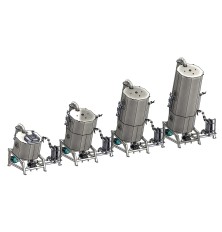
A circulation-type vacuum evaporator refers to a combined version of an evaporator that also takes advantage of other types to improve evaporation efficiency particularly by reducing concentration time and when processing heat-sensitive products such as milk.
- The external circulation circuit with heating intensifies the cyclic evaporation process.
- The forced circulation system ensures a decrease in the risk of localized product overheating.
- The condenser enables a deep vacuum and maintains a low evaporation temperature.
- Utilizing a mixing device with a spray system facilitates product evaporation in a thin layer, mimicking a film-type evaporator.
- Material: Stainless steel
- Principle of operation: Batch mode
- Country of origin: Slovakia
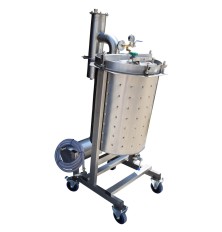
The price is set for the basic version of the vacuum evaporation unit with basic controls (mixer motor switch) and without additional options. The control unit is customized based on individual customer requirements. The pump is also selected separately depending on the product.
A compact vacuum evaporation unit that allows you to concentrate solutions, mixtures, and various products by evaporating the solvent. A modular version based on the basic version of the 110/100 vacuum reactor.
- Gravity mixing - 25% more efficient
- Reinforced agitator design with no blind spots
- Bottom ball valve with no dead zones
- Condensation and secondary vapor removal system
- Easy to disassemble mixing device
- Large heat exchange area
- Ability to measure and monitor condensate volume (optional)
- Material: Stainless steel
- Engine power, kW: 0,25
- Principle of operation: Continuous mode
- Country of origin: Slovakia
- Volume: 100l
- Voltage: 220-230V
- Max vacuum: -0,8 Bar
- Working volume: 50-80l
- Condensing capacity, l/h: 45-55
- Steam consumption, kg/h: up to 150
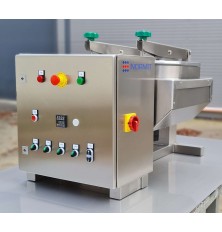
The price is indicated with a semi-automatic control panel
The vacuum cooking kettle is designed for use in public catering establishments (restaurants, hotels, catering companies) and small manufacturing businesses. This equipment enables boiling, blanching, frying, evaporation, pasteurization, mixing or stirring.
- A unique multifunctional device
- Possibility to cook/fry under atmospheric or vacuum conditions
- Laboratory version of a Vacuum Fryer
- Built-in condensation and secondary steam removal system
- Intense electric heating
- Sectional basket with a lid
- Built-in system for separating and removing excess liquid from the product
- Heating: Electric
- Material: Stainless steel
- Heating power, kW: 5
- Volume: 20l
- Oil volume: 8l
- Voltage: 380-400V
- Max vacuum: -0,8 Bar

Compact vacuum evaporation machine with an external circulation heat exchanger for the production of test batches of products, development of new recipes and technological maps.
- Compact installation
- Capable of replicating all processing techniques used in industrial vacuum evaporation units with circulation
- Preserves the natural taste, aroma and color of the product
- Can be used to produce small batches of products
- Material: Stainless steel
- Principle of operation: Batch mode
- Type of equipment: Individual machine
- Country of origin: Slovakia
- Volume: 20l
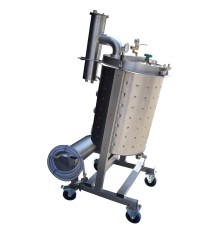
This equipment model is a universal system, which can be used to produce extracts from products like carobs, as well as to boil them under vacuum conditions to obtain a thick syrup through a sequential circulation process.
- One system for all sequential technological processes of pekmez production: from soaking and obtaining an extract, cooling the finished mixture to its boiling phase in a vacuum.
- Boiling under vacuum allows you to preserve all the useful substances contained in the extract: vitamins of group A, B, E, microelements such as calcium, potassium, magnesium, iron and zinc.
- Highly efficient boiling process due to a special direct in the flow heating system installed in the circulation type vacuum evaporation unit
- Heating: Electric
- Material: Stainless steel
- Heating power, kW: 36
- Volume: 100l
- Condensing capacity, l/h: 45-55

A vacuum distillation system is used for controlled separation of liquids based on the evaporation of the liquid and subsequent condensation of its vapors.
- Material: Stainless steel
- Country of origin: Slovakia
- Volume: 5l
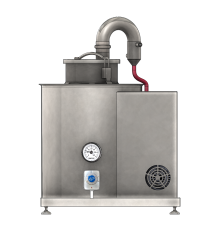
The unique feature of this vacuum honey evaporator model, distinguishing it from a honey dryer, is its ability to create a deep vacuum with a residual pressure of up to 0.08 Bar during processing, and thus lowering the processing temperature! This innovative unit not only allows for quick and efficient drying of honey but also enables the immediate evaporation of water, producing a semi-finished product suitable for the subsequent production of «dry honey» or powdered honey.
- There is no need to have a large drying surface – an evaporation mirror.
- There is no need to install a mixing device for thick and viscous products.
- Low evaporation temperature of moisture – water from honey, at which its quality and medicinal properties are not compromised, and the risk of HMF growth is reduced to almost zero.
- Fast and efficient dehydration of honey at a low processing temperature.
- Material: Stainless steel
- Principle of operation: Batch mode
- Max vacuum: -1 Bar

The vacuum cooking and concentration unit is designed for concentrating products at low temperatures (about 60 degrees) in a reactor with a discharged environment to preserve the color, nutritional value and useful natural substances in present in food products. Evaporation and concentration units are often used when cooking jams, sauces, as well as fruit or vegetable concentrates. The vacuum concentrator allows you to boil and concentrate heat-sensitive products without damaging or destroying their structure or proteins, such as milk.
- Inclined design - allows for gravity mixing, which is 40% more efficient than usual
- Quick and 100% emptying of the tank thanks to the inclined design with the mixer on
- Heating/cooling jacket (duplicator) for the working tank and bottom
- High hygiene standard - the output valve is located at the lowest hydraulic point of the reactor
- Material: Stainless steel
- Principle of operation: Batch mode
- Country of origin: Slovakia
- Volume: 300l/ 500l/ 875l
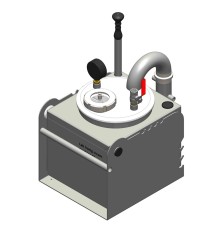
Small 3L vacuum processing unit with a stirring device and tilting function, for the production of non-alcoholic wine.
- Material: Stainless steel
- Principle of operation: Batch mode
- Type of equipment: Individual machine
- Country of origin: Slovakia
- Volume: 5l
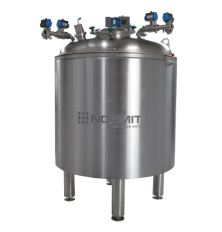
A vacuum evaporator is a device used to evaporate liquids at lower temperatures by creating a vacuum environment, which reduces the boiling point of the liquid and enables efficient evaporation without thermal degradation of sensitive materials. Working volume up to, l: 1900 l.
- Heating: Electric
- Material: Stainless steel
- Heating power, kW: 30
- Principle of operation: Batch mode
- Country of origin: Slovakia
- Working volume: up to 1900 l
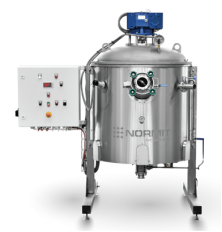
An evaporating unit is utilized to remove moisture from sweet substances through heating, transforming them into concentrated syrups or solutions.
- Material: Stainless steel
- Heating power, kW: 30
- Principle of operation: Batch mode
- Country of origin: Slovakia
- Voltage: 380-400V
- Geometric volume: 200 l

The vacuum evaporation unit is specially designed for thickening dense food products in industrial quantities. The evaporator can be used for the production of thick syrups, caramel masses, dense fruit masses, as well as for the production of pectin, or heat-stable fillings with a high productivity.
- High performance
- Rotary spraying system with a powerful electric drive
- Evaporation in a thin layer with a large heat transfer area
- Low investment installation costs
- Tangential entry for product swirling
- Material: Stainless steel
- Principle of operation: Batch mode
- Country of origin: Slovakia
- Voltage: 380-400V
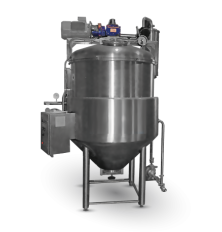
Price depends on the capacity and product.
- Material: Stainless steel
- Principle of operation: Batch mode
- Type of equipment: Individual machine
- Country of origin: Slovakia
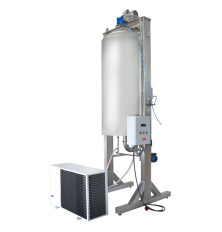
Plant for evaporating, concentrating and crystallizing solutions. Vacuum evaporator ensures a complete separation of the solution into a solid fraction and pure water.
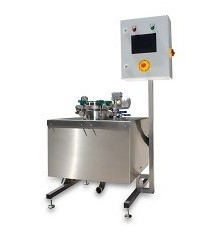
We offer different types of vacuum evaporation machines, this type is an affordable option for efficient evaporation in a stainless steel unit.
- Material: Stainless steel
- Principle of operation: Batch mode
- Volume: 100l
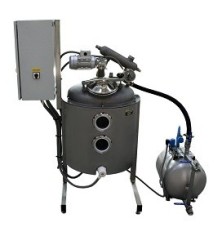
We offer wide range of evaporating equipment for a wide range of products. Price depends on the capacity and product used.
- Material: Stainless steel
- Principle of operation: Batch mode
- Country of origin: Slovakia
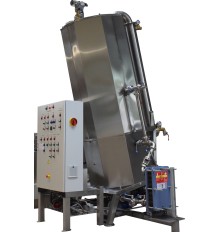
A circulation-type vacuum evaporator refers to a combined version of an evaporator that also takes advantage of other types to improve evaporation efficiency particularly by reducing concentration time and when processing heat-sensitive products such as milk.
- The external circulation circuit with heating intensifies the cyclic evaporation process.
- The forced circulation system ensures a decrease in the risk of localized product overheating.
- The condenser enables a deep vacuum and maintains a low evaporation temperature.
- Utilizing a mixing device with a spray system facilitates product evaporation in a thin layer, mimicking a film-type evaporator.
- Heating: Steam
- Material: Stainless steel
- Operation mode: Semi-automatic
- Country of origin: Slovakia
- Total power, kW: 2,4
- Voltage: 380-400V
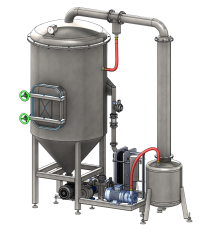
The concentration and thickening line line has been especially designed for industrial dairy production facilities with a small surplus of milk or smaller milk processing businesses that want to expand their product range. It has an estimated productivity of up to 50-120 kg/hour during continuous operation.
- Professional industrial technology with compact dimensions
- A large number of additional equipment and options to choose from
- Material: Stainless steel
- Principle of operation: Continuous mode
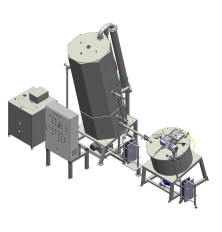
Equipment for the production of condensed milk from pre-pasteurized milk. This equipment can be manufactured with a capacity of 50 to 500 kg/hour, or on request. We also manufacture condensed milk lines according to TU from dry milk or normalized milk concentration lines.
- Material: Stainless steel
- Type of equipment: Part of a production line
- Country of origin: Slovakia
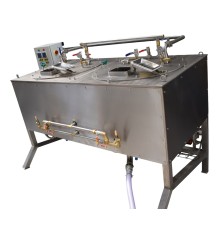
The compact line of double-type vacuum cooking kettles comprises a complex of batch food cooking units designed for periodic thermal processing, vacuum mixing, and deaeration of various products under sub-atmospheric pressure.
- Material: Stainless steel
- Principle of operation: Batch mode
- Country of origin: Slovakia
- Volume: 2x300l/ 2x600l
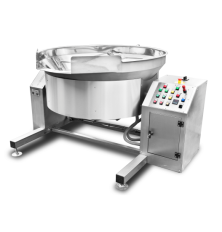
The Atmospheric Evaporating Pan efficiently concentrates liquids by evaporating them on a large surface area, while also being suitable for various cooking methods including braising, cooking, and roasting.
- Heating: Electric
- Material: Stainless steel
- Principle of operation: Batch mode
- Country of origin: Slovakia
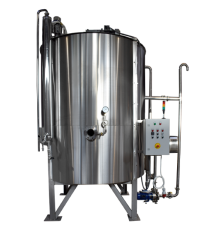
An evaporator concentrator-crystallizer is a multifunctional unit that concentrates liquids by evaporating water and inducing crystallization for the production of concentrated solutions or crystalline products.
- Material: Stainless steel
- Working volume: up to 6000 L
- Geometric volume: 6500 l


