


VACUUM TUMBLERS
Industrial vacuum tumblers for meat marination and processing
Vacuum tumblers, also known as meat tumblers or vacuum marinating machines, are used in meat processing to distribute marinades, seasonings and other ingredients throughout meat products. They combine controlled drum rotation with vacuum conditions to improve the efficiency and consistency of marination.
During tumbling, meat pieces repeatedly move and fall inside a rotating drum, creating a mechanical massaging action. This movement helps distribute the marinade over the product surface, promotes the uptake of liquid ingredients and supports the extraction of salt-soluble proteins. These proteins contribute to the binding, texture and moisture retention of processed meat products.
Vacuum operation helps remove air from the drum and from spaces between meat pieces. Depending on the process and equipment configuration, the combination of vacuum and mechanical action can improve marinade distribution and product consistency compared with static marination.
Vacuum tumblers are widely used by meat processors producing marinated cuts, seasoned meat products and prepared meat ingredients.
How vacuum tumblers work
A vacuum tumbler consists primarily of a rotating drum, a drive system and a vacuum arrangement. Internal paddles or specially shaped surfaces help move the meat as the drum rotates. The equipment may also include controls for rotation speed, operating time and vacuum level.
The marination process generally involves several stages:
- Loading: Meat pieces are placed inside the drum together with the required marinade, brine, spices or other ingredients.
- Vacuum application: Air is removed from the drum to establish the required reduced-pressure conditions.
- Mechanical tumbling: The drum rotates, lifting and gently dropping the meat. This repeated movement distributes the marinade and provides a massaging effect.
- Ingredient uptake: Mechanical action and vacuum conditions support the distribution and uptake of liquid ingredients. Salt and other functional ingredients can also promote the extraction of proteins that influence the texture and binding properties of the meat.
- Unloading: After the required processing time, the vacuum is released and the marinated product is discharged for further processing, storage or packaging.
The process can be adjusted according to the type and size of the meat pieces, marinade composition, loading level, rotation speed, vacuum level and processing time.
The role of vacuum in meat marination
Vacuum is an important feature of these machines because it changes the conditions inside the tumbling drum and helps remove air from the product environment.
When the pressure is reduced, air is removed from the spaces within and around the meat pieces. Subsequent pressure changes, together with mechanical tumbling, can assist the movement and distribution of marinade. Vacuum also helps limit excessive air incorporation during processing.
The effectiveness of marination depends on several factors, including meat structure, piece dimensions, salt concentration, marinade viscosity and the duration of tumbling. Vacuum alone does not guarantee that seasoning will penetrate uniformly to the centre of every piece; the mechanical action and formulation are equally important.
Benefits of vacuum tumbling
- More uniform marinade distribution:
- Improved ingredient uptake:
- Improved texture and binding:
- Better moisture retention:
- Reduced processing time:
- Repeatable processing:
Applications of vacuum tumblers
Vacuum tumblers are primarily used in meat and poultry processing, particularly where consistent marination, seasoning and product preparation are required.
- Poultry processing: Marinating chicken fillets, breast portions, wings and other poultry cuts with brines, marinades and seasoning mixtures.
- Beef processing: Preparing marinated steaks, strips, cubes and other beef portions for retail, food service and further processing.
- Pork processing: Marinating pork cuts, chops, pieces and other products with liquid seasonings and spice formulations.
- Prepared meat products: Processing meat pieces and portions intended for ready-to-cook meals, grilled products, barbecue ranges and other prepared foods.
- Meat ingredient preparation: Distributing brines and functional ingredients in meat products that require improved binding, texture and moisture retention.
Factors to consider when selecting a vacuum tumbler
The correct machine configuration depends on the type of meat, batch size and desired marination result.
- Working capacity: The amount of meat processed per batch. The usable loading volume should allow sufficient room for the product to tumble effectively.
- Drum design: Internal paddles, surfaces and geometry influence how the meat moves and how gently or intensively it is processed.
- Vacuum performance: The achievable vacuum level and its control should match the product and the intended marination process.
- Rotation speed: Adjustable speed allows the tumbling action to be adapted to different meat types and product structures.
- Processing time: Different cuts, piece sizes and formulations require different tumbling cycles.
- Product sensitivity: Fragile products require gentler handling to prevent excessive mechanical damage.
- Construction and hygiene: Food-contact materials, internal surface finish, drainage and ease of cleaning are important for hygienic meat processing.
- Production requirements: Consider loading and unloading arrangements, batch frequency and integration with cutting, preparation, cooking or packaging equipment.
Vacuum tumbling equipment from FoodTechProcess
FoodTechProcess offers vacuum tumblers for processing meat products in different capacities. These machines combine mechanical tumbling and vacuum operation to support marination, seasoning and preparation of meat and poultry products.
Whether processing smaller batches or larger production volumes, selecting the appropriate tumbler depends on the product type, required batch capacity and desired marination results. A properly selected machine helps improve process consistency and prepare meat products for subsequent cooking, packaging or distribution.
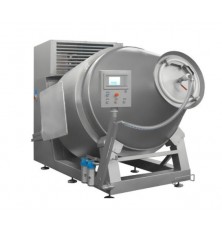
These meat tumblers are designed for removing air and drawing moisture and marinade into the meat under the conditions of a vacuum.
- Material: Stainless steel
- Principle of operation: Batch mode
- Volume: 600l/ 900/ 1200l/ 2000 3000
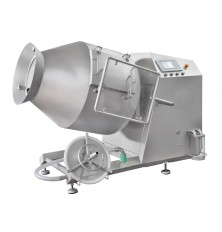
Meat tumblers are designed to remove air and draw moisture and marinade into the meat under vacuum conditions.
- Material: Stainless steel
- Principle of operation: Batch mode
- Volume: 300l/ 600l/ 900/ 1200l/ 2000 3000
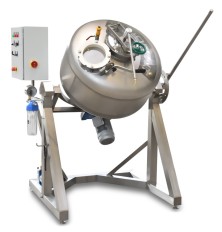
A vacuum diffuser is a device used in the food industry to remove oxygen from a product under vacuum conditions, primarily employed for enhancing the preservation of food by reducing oxidation and extending shelf life.
- Material: Stainless steel
- Principle of operation: Batch mode
- Type of equipment: Individual machine
- Country of origin: Slovakia
- Volume: 200l/ 1000l
- Voltage: 380-400V
- Max vacuum: -0,8 Bar
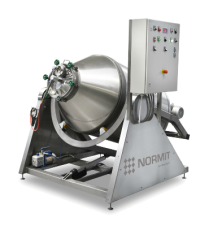
Vacuum coater is ideal for the application of salt and sugar solutions, enzyme, vitamin and anti-oxidants on water or oily basis as it ensures even distribution of small amounts of additives between the total product volume.
The price depends on the production capacity as well as the product being processed.
- Material: Stainless steel
- Principle of operation: Batch mode
- Country of origin: Slovakia
- Max vacuum: -0,8 Bar


