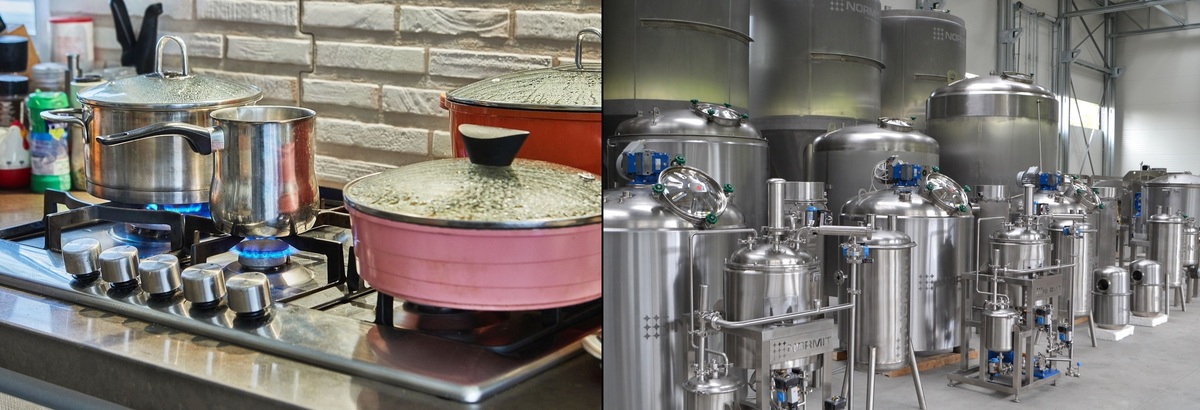
For many food entrepreneurs, every successful product begins in a home kitchen. When you want to produce your signature jam, a gourmet sauce, rich caramel, or a traditional syrup, the early stages of development are defined by experimentation and passion. However, as demand grows, consistency becomes essential, and home kitchen equipment usually reaches its limits. This is when transitioning to small-scale professional production becomes the natural next step.
Perfecting your recipe at home
The home kitchen is the ideal environment for testing and refining recipes. Small batches allow for flexibility in adjusting ingredients, textures, and flavors. At this stage, producers can validate their concept, gather feedback, and build confidence in their product.
As interest increases after advertising through farmers markets, local retailers, or online sales, the need for greater production efficiency and repeatability becomes apparent. Maintaining consistent quality across batches and ensuring food safety, as well as meeting growing demand becomes critical, but can be challenging with standard kitchen equipment.
Recognizing the right time to upgrade
Transitioning to professional production does not necessarily mean scaling to large industrial volumes. Instead, it involves utilizing equipment that enhances the efficiency of the process itself while preserving the artisanal nature of the product.
Producers should consider upgrading when:
- Demand exceeds the capacity of home kitchen equipment.
- Batch-to-batch consistency becomes critical.
- Manual mixing becomes time-consuming or physically demanding.
- Hygienic and efficient product discharge is needed.
- Compliance with food safety standards becomes a priority.
- Precise production process control is required.
Automating repetitive processes
Small-scale professional cooking kettles provide an effective solution by automating many of the repetitive tasks associated with food production.
Two practical options for small-scale producers
Modular cooking kettle with an attachable mixer lid
This configuration consists of a stainless-steel vessel with a sandwich bottom, paired with a professional mixer mounted on the lid. The kettle can be placed on electric or gas heating hobs, offering a flexible and economical solution for producers upgrading from home kitchens. Its simplicity and adaptability make it an excellent choice for a wide range of applications. It includes models suitable for processing liquids and semi-liquid products, as well as models suitable for handling viscous substances like caramel.
Mobile cooking kettle with mixing and tilting
For enhanced ergonomics and utility, the frame-mounted tilting model integrates several useful features:
- Manual tilting for gravity-assisted mixing (up to 50% more efficient) and complete discharge
- Bottom outlet valve for controlled emptying
- Caster wheels for easy mobility
- Robust stainless steel construction suitable for professional environments
This solution is particularly well suited for producers seeking to improve workflow within their production facilities.
Powerful industrial mixing
Professional cooking kettles are equipped with industrial geared motors and reinforced stirrers designed to handle high-viscosity products. This enables efficient and uniform mixing of dense substances including:
- Caramel and fudge
- Fruit jams and preserves
- Syrups and honey-based products
- Sauces and spreads
- Pastes and fillings
Continuous, controlled mixing ensures a homogeneous product and also reduces manual labor and operator fatigue.
Temperature management is also essential for achieving consistent batches, particularly in processes such as cooking, pasteurization, and sugar-based formulations. Professional cooking kettles allow producers to accurately monitor and maintain the desired temperature throughout the production cycle.
Depending on the production environment, the cooking kettles can be used with electric (even if only a 220V–240V electrical network is available) or gas heating hobs, offering flexibility and adaptability to different environments.
Hygienic and efficient discharge
Efficient product handling is another key advantage of professional equipment. A bottom discharge valve allows for controlled and hygienic emptying of the kettle, minimizing product loss and simplifying the subsequent filling of containers. This feature significantly improves workflow and cleanliness compared to manual transfer methods or having spill the contents over the edge of a vessel.
Tilting cooking kettles functionality
For producers seeking additional operational flexibility, frame-mounted tilting cooking kettles provide further benefits. These models are installed on sturdy legs and caster wheels, allowing easy movement within a production facility.
A manual tilting mechanism with 8 locking positions and a maximum tilting angle of 100°, enables gravity-assisted mixing, and also ensures complete unloading of the finished product. This is particularly advantageous when processing thick or sticky materials, as it reduces residue and simplifies cleaning. In addition to tilting, the presence of a bottom valve offers multiple discharge options.
Why starting with large industrial equipment is not always ideal
When transitioning to professional production, it may be tempting to invest in large industrial equipment, such as the 250 liter professional cooking kettle, or a Cook & Chill cooking kettle to immediately stop the cooking process and prevent overcooking. However, this approach often introduces significant challenges and risks for small producers, including:
- High initial investment costs
- Increased energy consumption
- Greater space requirements
- Reduced flexibility for recipe adjustments
- Higher operational risk if demand fluctuates
In contrast, 50 liter or 100 liter cooking kettles provide the ideal balance between capacity and flexibility. They are sufficiently large to support commercial production while remaining cost-effective and manageable for small businesses. Their relatively low initial investment costs allows for easy expansion by acquiring a second unit.
Preserving the artisan approach
Adopting professional equipment does not mean sacrificing the handcrafted quality that defines artisan food products. On the contrary, it enables producers to maintain their unique recipes while ensuring consistent batch quality, improved hygiene standards, and increased throughput. Reducing manual workload and variability allows producers to focus more on creativity, branding, and market expansion.
Investing in a simple 50 or 100 liter cooking kettle allows producers to automate repetitive processes without the financial and logistical burden of large industrial systems.