


EXTRUDERS
Industrial food extruders for shaping and processing food products
Extruders are used in food processing to form, shape or transform food mixtures by forcing them through a specially designed die under controlled pressure. The extrusion process allows ingredients to be converted into continuous strands, sheets, portions or products with defined cross-sections and dimensions.
Depending on the equipment design and the material being processed, extrusion can involve simple mechanical forming or more intensive processing under controlled temperature and pressure. Some machines are designed primarily for shaping prepared mixtures, while cooking extruders also use heat and mechanical energy to modify the structure and texture of the raw material.
Food extruders are used in the production of cereal and protein bars, confectionery, snacks and other formed food products. Specialized systems are also applied to meat products, pasta and pet food, although the required equipment differs considerably between these applications.
How food extrusion works
The raw material is prepared as a mixture or dough with suitable consistency and supplied to the extruder through a feeding hopper or feeding system. Inside the machine, one or more screws, pistons or other conveying mechanisms move the material towards the forming head.
As the product advances, it is compressed and directed through a die that determines its shape and dimensions. Depending on the process, temperature and pressure may also be controlled to achieve the required texture, consistency or structural changes.
A typical extrusion process includes the following stages:
- Ingredient preparation: Raw materials are mixed and prepared to achieve the required composition, moisture content and consistency.
- Feeding: The prepared mixture is supplied to the extruder at a controlled rate. Consistent feeding helps maintain stable operating conditions.
- Conveying and compression: The internal mechanism moves the material towards the extrusion head, generating the pressure needed for processing and forming.
- Extrusion through the die: The material passes through an opening with a defined shape and cross-section, producing a continuous strand, sheet or other formed product.
- Cutting and further processing: Depending on the application, the extruded material can be cut into individual portions, cooled, dried, coated or subjected to other downstream operations.
The final product characteristics depend on the formulation, moisture content, temperature, pressure, screw configuration, feeding rate and die geometry. These parameters must be matched to the properties of the mixture and the desired result.
Types and configurations of food extruders
Extruders differ in their conveying mechanism, number of screws, operating conditions and intended application.
Single-screw extruders use one rotating screw to convey and compress the material towards the die. They are used in processes where the product can be handled effectively by a single conveying and forming mechanism.
Twin-screw extruders use two screws operating within the same barrel. Depending on their arrangement and direction of rotation, they can provide effective conveying, mixing and processing of more complex formulations. Twin-screw systems are commonly used in applications requiring greater control over ingredient distribution and material handling.
Another important distinction is between forming extruders and cooking extruders. Forming extruders primarily shape a prepared mixture, while cooking extruders combine conveying, compression, mixing and thermal processing. In thermal extrusion, the interaction of temperature, pressure, moisture and mechanical energy can change the structure of the raw material before it exits through the die.
The appropriate configuration depends on the product and the specific operation required. A machine designed to form cereal bars, for example, does not necessarily have the same construction or operating principle as an extruder used to produce expanded snacks or cooked pasta.
Applications of extruders in food production
Extrusion technology is used in several areas of food manufacturing, with equipment configurations adapted to the properties of each product.
- Cereal and protein bars: Extruders can form prepared mixtures containing cereals, grains, nuts, protein ingredients, binders and syrups into continuous strips or defined shapes. The material can then be cut into individual bars and transferred to cooling, coating or packaging operations.
- Snacks and extruded products: Cooking extruders are used to process suitable cereal, starch-based and other formulations into shaped snack products. Depending on the formulation and process conditions, extrusion can create specific textures and structures, including expanded products. Further operations may include drying, seasoning and coating.
- Confectionery: Extruders can shape suitable confectionery masses into continuous strands, ropes or other forms. The extruded material may subsequently be cut, cooled or coated with chocolate and other coverings.
- Meat and formed products: Specialized forming extruders can process meat mixtures and plant-based formulations into portions with consistent dimensions. The equipment must be designed for the specific mixture and required product structure.
- Pasta and pet food: Cooking extrusion is also used in pasta and pet food production. These applications require dedicated equipment and process configurations to achieve the appropriate structure, cooking characteristics and final product properties.
Selecting an extruder for production
The selection of an extruder begins with the product formulation and the required finished shape. Ingredients, moisture content, viscosity, particle size and temperature sensitivity all influence how the mixture behaves during conveying and forming.
The required capacity and operating mode are also important. Batch feeding and continuous production place different demands on the equipment, while screw configuration, drive power and die design determine the range of products that can be processed.
Other factors include the required level of temperature and pressure control, cutting arrangements, cleaning requirements and integration with downstream equipment. For products such as bars and snacks, the extruder may form only one part of a larger production line that includes mixing, cooling, cutting, coating and packaging.
FoodTechProcess offers extrusion equipment for shaping and processing different food mixtures, including cereal and protein bar masses, confectionery, extruded chips and other snack products. The appropriate machine configuration depends on the raw materials, required product shape, production capacity and processing conditions.
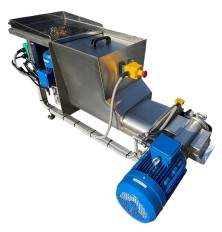
A twin-screw mixer with a homogenizer is an ideal solution for the production of creamy cheese, such as feta cheese, including with various flavors and seasonings. Thanks to mechanical homogenization, the cheese acquires a delicate structure without changing the individual taste properties of the product. It is used for plasticizing, creaming and softening butter, margarine and other fats.
- Capacity of the receiving hopper 50L
- Compact tabletop design for convenient operator maintenance
- A powerful independent drive for each screw with a reverser
- Easy maintenance and cleaning of the equipment
- Productivity: 250 kg/h/ 1500 kg/h
- Material: Stainless steel
- Principle of operation: Continuous mode
- Country of origin: Slovakia
- Total power, kW: 3,5
- Voltage: 380-400V
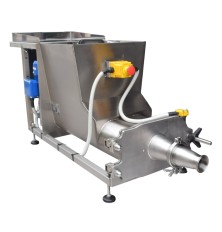
Twin-screw extruder is designed for effective extruding, homogenization, pumping over of plastic masses (butter, margarine, honey, curd products, confectionery mixtures), and forming it into bars and rolls.
Product consistency: The extruder is designed for firm but plastic product masses, typically at a temperature of around 12 °C. Suitable products include butter, margarine, and other similar plastic food masses.
- Productivity: 400 kg/h
- Material: Stainless steel
- Principle of operation: Continuous mode
- Country of origin: Slovakia
- Weight: 115 kg
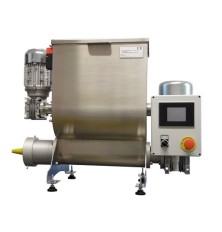
A sturdy extruder machine, with a tank made from AISI 304 stainless steel, ideal for extruding and mixing, and the production of protein bars. For a mini line for making boilie, you can purchase our boilie rolling machine.
- Material: Stainless steel
- Engine power, kW: 0,55/ 0,75
- Principle of operation: Continuous mode


