


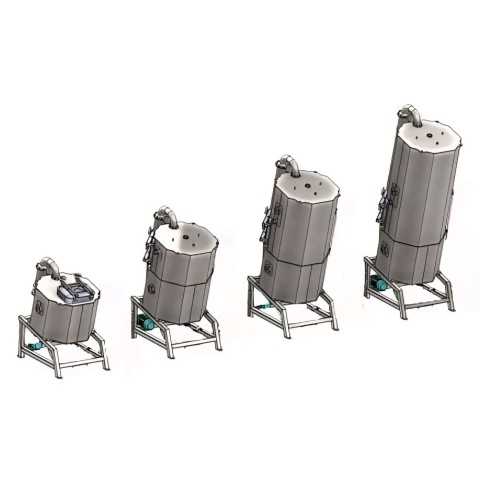

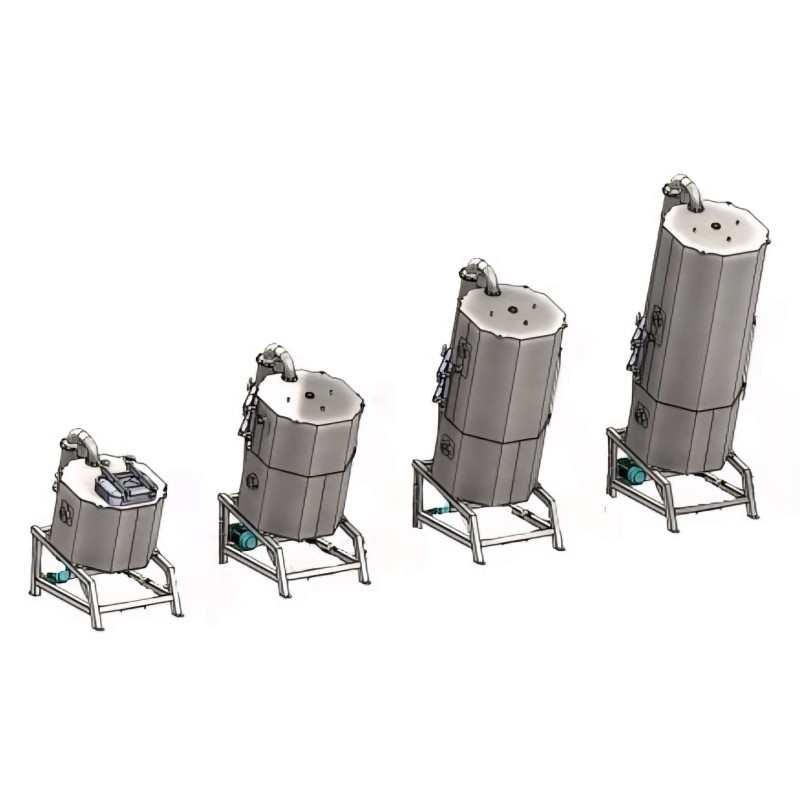
Vacuum evaporators 50–1800 L
Vacuum evaporators are designed for concentration and thermal processing of liquid and semi-liquid products under reduced pressure, enabling evaporation at lower temperatures for preserving product quality. FT Mak evaporators utilize efficient heat transfer, controlled vacuum conditions, and internal mixing to achieve stable and repeatable processing results.
- Reduced boiling temperature under vacuum preserves beneficial product qualities
- Efficient evaporation with external heating through a duplicator
- Uniform processing without local overheating
- Wide range of options from 50 to 1800 L for different production capacities
Evaporation systems are used in the food industry as well as in the chemical, pharmaceutical, and cosmetics sectors. Concentration often serves as the primary process, but also as an intermediate step before drying various liquid or flowing products. The evaporation process involves thickening liquid masses by extracting a solution (usually water) from them in the form of steam, which is then removed from the working chamber of the equipment.
Vacuum evaporation systems are used for processing products such as:
- juice concentration
- condensation of milk and cream
- production of thermostable fillings
- cooking syrups
- jam and fruit preparations
- drying various solutions (including oils)
- processing heat-sensitive proteins
- fruit and vegetable purees with preserved color and taste
- baby food production
- sugar paste and confectionery masses
Vacuum evaporators can also function as cooking systems in the confectionery and dairy industries, allowing thermal processing under reduced pressure and temperature conditions. By lowering the boiling point, vacuum processing prevents caramelization, minimizes thermal damage, and helps preserve natural taste, color, vitamins, and nutrients.
The vacuum evaporators in this series are designed as hybrid single-effect systems, with a combination of energy effective heat transfer, internal mixing, and controlled vacuum to achieve optimal evaporation performance and maintain intended product integrity. The range from 50 to 1800 L allows adaptation from pilot production to full industrial processing.
Advantages
- The slanted design of the evaporator’s working reactor ensures maximum emptying of the vessel, with the outlet valve positioned at the lowest hydraulic point, minimizing product losses and eliminating the need for complex discharge systems.
- Gravity mixing improves the processing efficiency compared to conventional mixing methods. The product continuously circulates within the vessel, ensuring uniform distribution of temperature and ingredients. Optional scrapers enhance mixing and prevent product buildup on the walls.
- The combination of a vessel with a jacket (duplicator) and the frame mixing device enables efficient heat transfer without localized overheating. Continuous product movement ensures stable evaporation conditions and protects heat-sensitive materials.
- Vacuum processing significantly reduces the boiling temperature (e.g. at a residual pressure of ~0.2 bar, the boiling point drops to ~60 °C), preserving product quality, preventing unwanted chemical changes, and maintaining natural sensory properties such as flavor, color, and aroma.
- The evaporation process can occur in a thin layer along the heated walls, increasing the effective heat exchange surface and improving overall evaporation intensity.
- A vapor removal and condensation system supports stable vacuum conditions and efficient removal of evaporated moisture from the process chamber.
- The system is suitable for a wide range of viscosities and product types, from low-viscosity liquids to thicker concentrates.
Basic version
The vacuum evaporator consists of a 2-layer vacuum vessel with a bottom and side heat transfer jacket (duplicator), which can be configured to operate as a 1/3 heating zone if necessary, mounted on a stainless steel supporting structure. The unit is equipped with a mixing motor and stirrer, ensuring continuous product movement during evaporation. A vacuum lid is installed on the vessel, with larger models featuring a plexiglass inspection window for visual control of the process.
The system includes a basic vacuum generator (compressed air ejector), with other vacuum generation options such as a vacuum pump available upon request. The unit is equipped with a condenser for condensing extracted vapors, connections for vacuum generation and a secondary vapor removal system. All parts in contact with the product are made of food-grade stainless steel suitable for hygienic processing.
The control system for adjusting key process parameters, including temperature, mixing speed, and vacuum level, depends on the required degree of automation. The unit is equipped with essential safety features, basic controls, and shut-off valves for stable and reliable operation.
A vapor collector (trap) can be offered as an additional option.
Technical conditions
- Working vacuum depth: up to -0.8 bar (approx. 0.2 bar residual pressure)
- Evaporation temperature under vacuum: approx. 55–60 °C (depending on conditions)
- Recommended loading volume: 50–75% of total capacity (depending on product properties)
- Available volumes: 50 / 100 / 200 / 300 / 600 / 900 / 1200 / 1800 L
Additional options
- Scrapers for the mixing device (stainless steel, PTFE, or PEEK)
- Enhanced vacuum set for deeper vacuum levels
- Vapor collector (trap)
- Product spraying system for improved evaporation efficiency
- CIP cleaning system
- Thermal insulation with decorative casing
- Selection of heating source (steam or hot water)
- Customized control systems (including PLC automation)
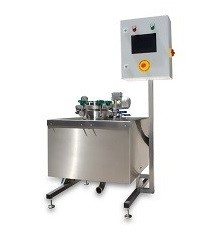
We offer different types of vacuum evaporation machines, this type is an affordable option for efficient evaporation in a stainless steel unit.
- Material: Stainless steel
- Principle of operation: Batch mode
- Volume: 100l

The vacuum cooking and concentration unit is designed for concentrating products at low temperatures (about 60 degrees) in a reactor with a discharged environment to preserve the color, nutritional value and useful natural substances in present in food products. Evaporation and concentration units are often used when cooking jams, sauces, as well as fruit or vegetable concentrates. The vacuum concentrator allows you to boil and concentrate heat-sensitive products without damaging or destroying their structure or proteins, such as milk.
- Inclined design - allows for gravity mixing, which is 40% more efficient than usual
- Quick and 100% emptying of the tank thanks to the inclined design with the mixer on
- Heating/cooling jacket (duplicator) for the working tank and bottom
- High hygiene standard - the output valve is located at the lowest hydraulic point of the reactor
- Material: Stainless steel
- Principle of operation: Batch mode
- Country of origin: Slovakia
- Volume: 300l/ 500l/ 875l
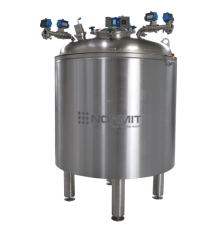
A vacuum evaporator is a device used to evaporate liquids at lower temperatures by creating a vacuum environment, which reduces the boiling point of the liquid and enables efficient evaporation without thermal degradation of sensitive materials. Working volume up to, l: 1900 l.
- Heating: Electric
- Material: Stainless steel
- Heating power, kW: 30
- Principle of operation: Batch mode
- Country of origin: Slovakia
- Working volume: up to 1900 l
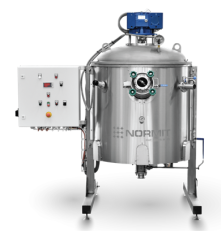
An evaporating unit is utilized to remove moisture from sweet substances through heating, transforming them into concentrated syrups or solutions.
- Material: Stainless steel
- Heating power, kW: 30
- Principle of operation: Batch mode
- Country of origin: Slovakia
- Voltage: 380-400V
- Geometric volume: 200 l
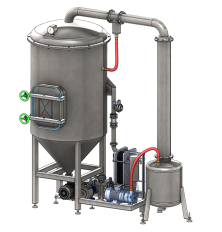
The concentration and thickening line line has been especially designed for industrial dairy production facilities with a small surplus of milk or smaller milk processing businesses that want to expand their product range. It has an estimated productivity of up to 50-120 kg/hour during continuous operation.
- Professional industrial technology with compact dimensions
- A large number of additional equipment and options to choose from
- Material: Stainless steel
- Principle of operation: Continuous mode
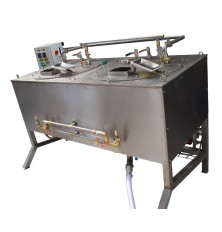
The compact line of double-type vacuum cooking kettles comprises a complex of batch food cooking units designed for periodic thermal processing, vacuum mixing, and deaeration of various products under sub-atmospheric pressure.
- Material: Stainless steel
- Principle of operation: Batch mode
- Country of origin: Slovakia
- Volume: 2x300l/ 2x600l
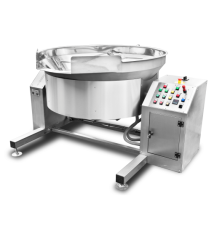
The Atmospheric Evaporating Pan efficiently concentrates liquids by evaporating them on a large surface area, while also being suitable for various cooking methods including braising, cooking, and roasting.
- Heating: Electric
- Material: Stainless steel
- Principle of operation: Batch mode
- Country of origin: Slovakia
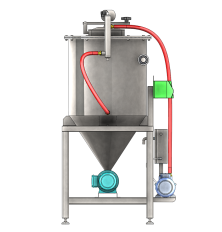
A vacuum deaerator is extensively used in the food industry to remove gases from products that may retain some bubbles post-processing. Additionally, a flow deaerator is utilized to minimize foaming in products, ensuring a denser structure, especially prior to packaging. Vacuum deaerators play a crucial role in eliminating specific odors from the products, such as in the production of juices, purees, and herbal drinks. This process significantly contributes to enhancing the overall quality and taste of the final product.
- Enhances product quality, structure, and shape
- Prevents oxidation by removing gases
- Preserves organoleptic properties and extends the shelf life
- Suitable for thick and viscous products
- The flow principle allows for the installation of this equipment in existing production lines
- Material: Stainless steel
- Principle of operation: Continuous mode
- Country of origin: Slovakia
- Voltage: 380-400V
- Max vacuum: -0,8 Bar

Compact vacuum evaporation machine with an external circulation heat exchanger for the production of test batches of products, development of new recipes and technological maps.
- Compact installation
- Capable of replicating all processing techniques used in industrial vacuum evaporation units with circulation
- Preserves the natural taste, aroma and color of the product
- Can be used to produce small batches of products
- Material: Stainless steel
- Principle of operation: Batch mode
- Type of the equipment: Individual machine
- Country of origin: Slovakia
- Volume: 20l
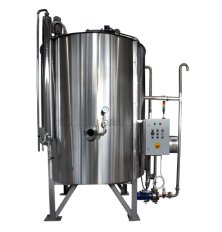
An evaporator concentrator-crystallizer is a multifunctional unit that concentrates liquids by evaporating water and inducing crystallization for the production of concentrated solutions or crystalline products.
- Material: Stainless steel
- Working volume: up to 6000 L
- Geometric volume: 6500 l

Small 3L vacuum unit with a stirring device for the production of non-alcoholic wine.
- Material: Stainless steel
- Principle of operation: Batch mode
- Type of the equipment: Individual machine
- Country of origin: Slovakia
- Volume: 5l
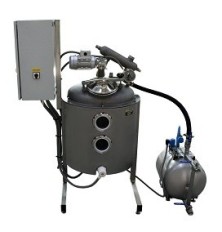
We offer wide range of evaporating equipment for a wide range of products. Price depends on the capacity and product used.
- Material: Stainless steel
- Principle of operation: Batch mode
- Country of origin: Slovakia

The vacuum evaporation unit is specially designed for thickening dense food products in industrial quantities. The evaporator can be used for the production of thick syrups, caramel masses, dense fruit masses, as well as for the production of pectin, or heat-stable fillings with a high productivity.
- High performance
- Rotary spraying system with a powerful electric drive
- Evaporation in a thin layer with a large heat transfer area
- Low investment installation costs
- Tangential entry for product swirling
- Material: Stainless steel
- Principle of operation: Batch mode
- Country of origin: Slovakia
- Voltage: 380-400V
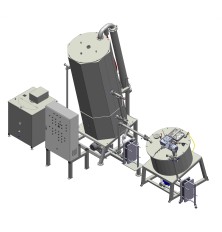
Equipment for the production of condensed milk from pre-pasteurized milk. This equipment can be manufactured with a capacity of 50 to 500 kg/hour, or on request. We also manufacture condensed milk lines according to TU from dry milk or normalized milk concentration lines.
- Material: Stainless steel
- Type of the equipment: Part of a production line
- Country of origin: Slovakia
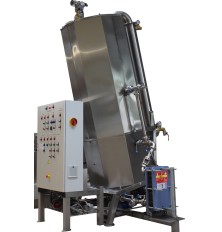
A circulation-type vacuum evaporator refers to a combined version of an evaporator that also takes advantage of other types to improve evaporation efficiency particularly by reducing concentration time and when processing heat-sensitive products such as milk.
- The external circulation circuit with heating intensifies the cyclic evaporation process.
- The forced circulation system ensures a decrease in the risk of localized product overheating.
- The condenser enables a deep vacuum and maintains a low evaporation temperature.
- Utilizing a mixing device with a spray system facilitates product evaporation in a thin layer, mimicking a film-type evaporator.
- Heating: Steam
- Material: Stainless steel
- Operation mode: Semi-automatic
- Country of origin: Slovakia
- Total power, kW: 2,4
- Voltage: 380-400V

This equipment model is a universal system, which can be used to produce extracts from products like carobs, as well as to boil them under vacuum conditions to obtain a thick syrup through a sequential circulation process.
- One system for all sequential technological processes of pekmez production: from soaking and obtaining an extract, cooling the finished mixture to its boiling phase in a vacuum.
- Boiling under vacuum allows you to preserve all the useful substances contained in the extract: vitamins of group A, B, E, microelements such as calcium, potassium, magnesium, iron and zinc.
- Highly efficient boiling process due to a special direct in the flow heating system installed in the circulation type vacuum evaporation unit
- Heating: Electric
- Material: Stainless steel
- Heating power, kW: 36
- Volume: 100l
- Condensing capacity, l/h: 45-55